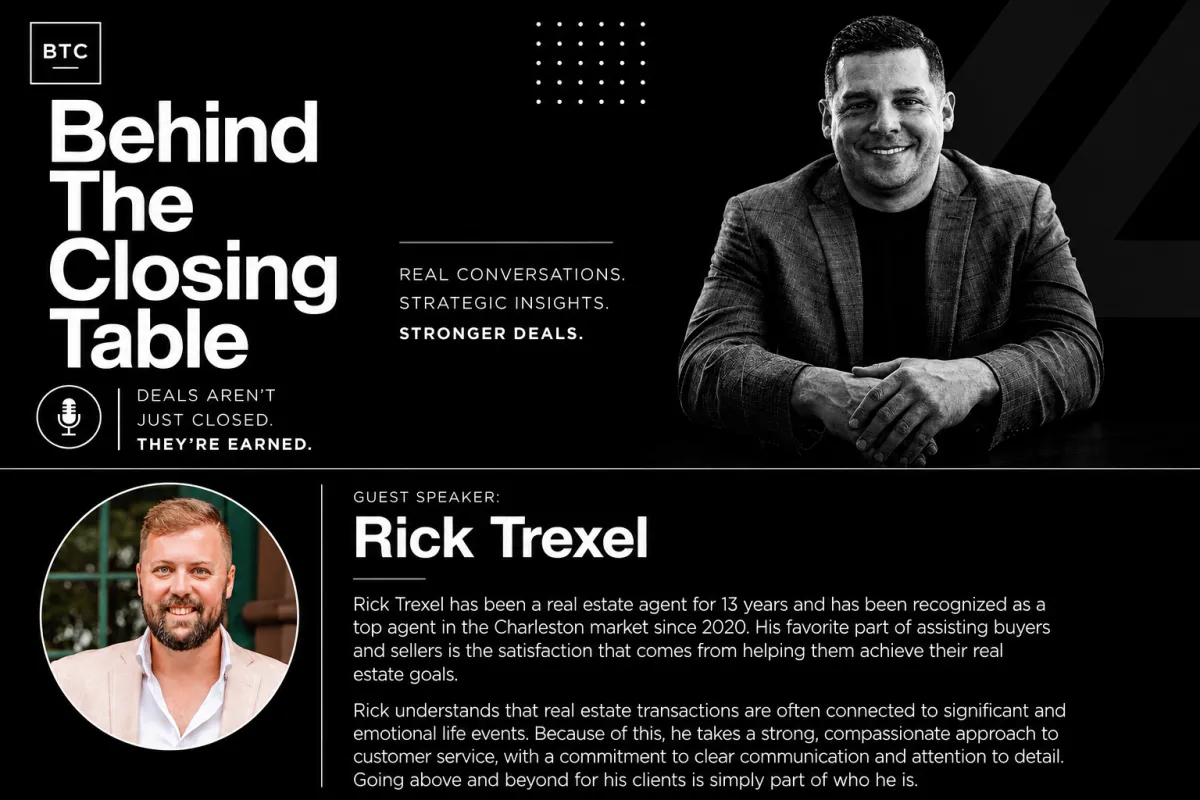
Behind the Closing Table With Rick Trexel: Thirteen Years in Charleston and What It Takes to Last
Behind the Closing Table With Rick Trexel: Thirteen Years in Charleston and What It Takes to Last
From Restaurant Nights and Real Estate Days to Charleston's Tri-County Market
Matt Brady sat down with Rick Trexel of Coldwell Banker in Charleston, South Carolina for a Behind the Closing Table conversation that covers thirteen years of surviving market cycles, what the Charleston market looks like right now depending on which part of the tri-county area you are in, and why Rick has sold more houses by helping clients not buy them than by pushing every deal to close.
Matt and Rick go back to the Beef O'Brady's days when Rick was running the restaurant at night and doing real estate during the day. He eventually made the full move to real estate, then relocated from the Fort Mill area to Charleston and had to rebuild his business from scratch in an entirely different market. Same license. Completely different animal.
Why Charleston Is Not One Market
The single most important thing to understand about the Charleston area is that it is not a single market. Within a thirty-minute drive the conditions facing buyers and sellers can be completely different and working with an agent who is not hyper-local to the specific submarket you are targeting is one of the most expensive mistakes a buyer or seller can make right now.
Downtown Charleston and the Mount Pleasant area and the islands remain popular, relatively active, and fairly balanced. These areas maintain consistent demand driven in part by proximity to beaches, the harbor, and the restaurants and culture that make Charleston one of the most desired relocation destinations in the Southeast. About 33 people a day are still moving to Charleston and that steady inflow keeps the core market from softening dramatically.
Summerville is a completely different story. It holds almost a third of all the inventory in the entire Charleston MLS. New construction and resale are competing side by side across a massive footprint of inventory and Rick describes the Summerville market as having genuinely shifted into buyer's market territory. Homes have been sitting for months in some cases. Sellers who have been unwilling to negotiate are increasingly making adjustments on price, closing costs, and terms. For buyers with patience and a good agent the deals available in Summerville right now are real.
Hanahan is the hidden gem Rick identifies for buyers who want Charleston proximity at a more accessible price point. Most people do not think of Hanahan when they think of Charleston. Rick thinks they should. It is about as close to Charleston as you can get without being inside the city limits. The three hundreds and four hundreds can get you into a decent property in a decent location roughly twenty minutes from downtown and thirty minutes from the beaches. It is underrated and underpriced relative to what the location actually provides.
The Short-Term Rental Warning Every Investor Needs to Hear
Charleston's relationship with short-term rentals has been tightening consistently and anyone considering a purchase with Airbnb or VRBO income as part of the financial justification needs to understand the regulatory environment before they make an offer rather than after.
There is an entire city department dedicated to enforcing short-term rental restrictions. The rules cover which areas qualify, caps on the number of permitted rentals, and what happens when operators try to get around the restrictions. The qualified zones represent a narrow slice of what the city originally allowed and the trend is toward further restriction rather than expansion. Rick's advice is consistent. If you are buying with short-term rental income as a component of the financial model make sure the numbers work for long-term rental too because the rules can change and protecting yourself against that possibility is the smart play.
What the Spring Market That Did Not Really Happen Tells Us
The beginning of 2026 felt like spring was coming. Rates had been elevated for a couple of years and there was genuine momentum building as buyers who had been waiting started to re-engage. Then the oil market disruption hit and things slowed down considerably. The proper spring market that felt like it was arriving never fully materialized.
What Rick is seeing now is the delayed version of that activity. People who need to make moves are making them regardless of the rate environment. Life changes, family changes, and relocations do not wait for perfect conditions and the buyers who are in the market now are the motivated ones. That creates a more productive transaction environment than the lunchtime buyers of 2020 and 2021 who bought simply because three percent rates made it feel irresponsible not to.
What Makes Agents Fizzle Out in the First Few Years
Rick's answer tracks with what every experienced agent says but he delivers it with the directness of someone who has watched it happen repeatedly over thirteen years.
People get into real estate because of HGTV and the Property Brothers and the impression that agents make a lot of money without doing much work. They get their license, look at their calendar, see nothing scheduled, and decide it is a day off. It is not a day off. An empty calendar means you are unemployed and your job today is to fill tomorrow's calendar.
The work you do today produces a paycheck ninety days from now if you are lucky. Real estate runs on a delayed compensation model that catches most new agents off guard. You grind and grind and then three months later you see the result. If you stop grinding when you get busy you will see the result of that too, in the form of a dead pipeline after the current deals close.
How Rick Handles Listing Appointments in This Market
Thirteen years in the market gives Rick the credibility to have the honest conversation with sellers that newer agents struggle to have. But the conversation starts before pricing. It starts with why.
Why are you moving? What is prompting this decision? Because the answer to that question determines how the rest of the conversation should go. Rick has walked out of listing appointments recommending sellers stay put because the numbers did not make sense for their situation. Going from a 2.75 percent mortgage to a 6 percent mortgage is a significant financial change and unless the reason for moving is compelling enough to justify that change it may not be the right time to sell.
When sellers do move forward the pricing conversation is built on data and it includes a pre-agreed plan. He pulls the comps, explains what the market is doing and which direction it is trending, and tells sellers directly when he disagrees with the price they want to list at. Then he asks them to agree upfront to specific price reduction triggers on a defined timeline if the activity metrics are not met. If the house has zero showings and no offers after a week at the seller's chosen price the price reduction conversation is already settled. There is no negotiation at that point. It was already agreed to before the sign went in the yard.
He also emphasizes that pricing is no longer just about what recently sold. In a market with six thousand homes available you have to know where your listing sits relative to the active competition. Buyers have Zillow and Realtor.com and they are comparing your home to the nineteen other homes in the same neighborhood before they ever book a showing. If your home is positioned poorly in that comparison set the comps from six months ago are irrelevant.
Top Three Budget-Friendly Things Sellers Can Do to Prepare a Listing
Curb appeal is first and it is not negotiable. The opinion a buyer forms when they pull up to a property shapes how they experience everything inside. Great curb appeal creates optimism and buyers walking through an optimistic mindset are more forgiving of minor imperfections. Poor curb appeal creates skepticism and buyers with a negative first impression will find things wrong with a house that they would have easily overlooked if they had arrived feeling good. Trim the bushes, edge the lawn, pressure wash the driveway, and make the outside say something worth walking into.
Fresh neutral paint is second. The beige palette of the early 2010s is visibly dated and updating to the grays, muted blues, and coastal-influenced tones that are current in the Charleston market makes a significant difference in how a home photographs and how it feels to buyers who grew up on design-forward renovation content. It is one of the highest return investments a seller can make relative to the cost.
Decluttering is third and it is free. Rent a storage unit if you need to. Clear the garage. Remove the personal photos and the collections and the furniture that makes rooms feel smaller. Buyers need to be able to picture themselves in the space and excess personal items prevent that psychological shift from happening. A home that feels spacious and neutral gives buyers the mental room to imagine their own life there.
What Buyers Are Getting Wrong Right Now
The biggest mistake Rick sees is buyers who have not updated their mindset from the 2020 and 2021 market. In those years you waived everything, paid over asking, skipped inspections, and still felt fortunate to get a house. That market is gone and continuing to operate with that mindset is costing buyers the due diligence protections they now actually have time to exercise.
Rick had a client recently do a sewer scope on a property for only the second time in thirteen years. Some buyers go further than others in their due diligence and Rick gives each buyer a full list of what they can do and lets them prioritize according to their comfort level and risk tolerance. The point is that buyers now have the time and the leverage to be thorough. Using that opportunity is one of the smartest moves a buyer can make in this market. Getting the seller to cover some of the inspection and due diligence costs is also realistic in many parts of the Charleston market right now.
Myth or Fact: Rick's Quick Takes
Open houses sell homes. Mostly myth. Rick has sold two houses in thirteen years specifically because of an open house. He has done hundreds of open houses. The primary value is lead generation for the agent, exposure for the listing, and an opportunity for buyers to explore properties without the pressure of having their agent present. It can help indirectly but it is not a reliable selling tool.
The highest offer is always the best offer. Myth. Terms matter as much as price. A high offer contingent on a sale that is not yet listed is often worth less than a lower offer with clean terms and a strong pre-approval. Rick has had sellers take less money for more certainty many times and they were right to do so.
You should always start with a low ball offer. Myth. Sellers in this market can and do simply walk away from offensive offers rather than counter. Doing your research and making a grounded offer that leaves room to negotiate is a better strategy than anchoring so low that you eliminate yourself from the conversation entirely.
A great realtor will talk you out of buying a home. True. Rick has walked out of listing appointments, steered buyers away from homes they were excited about, and passed on deals that did not make sense for the client. He would rather protect a client's financial interest and lose a commission than push a deal to close that the client will regret. That reputation is what produces the repeat business and referrals that have built his practice over thirteen years.
The cheapest house in the best neighborhood beats the nicest house in an average neighborhood. True, particularly for investors. The most upside is in the home with the most room to improve in the location with the strongest supporting values.
You make your money when you buy, not when you sell. Rick pushes back on this one. You have to sell to realize the gain. The buying decision matters but the selling decision is where the money actually lands.
What Rick Wants Clients to Remember
Rick does not pay for leads and he is not on a team. Every client comes through repeat business or a referral from someone he served well previously. That business model only works if people walk away from transactions feeling like Rick went further than any other agent would have gone.
He has helped clients move furniture. He has handled plumbing situations. He has shown up with a truck and a trailer. Whatever the transaction needed that fell outside the formal job description Rick has done it because he cares about the outcome and he wants clients to remember that the person they worked with actually showed up for them beyond what was required.
He is currently helping someone move items out of a garage before a listing shoots to ensure the home presents correctly. That is happening because he took responsibility for the outcome of the listing rather than handing the client a list of vendors and stepping back.
The referral that lands because someone told a friend that Rick helped them install their washer and dryer is the kind of referral that comes from that approach. And Rick has been earning those referrals for thirteen years, including clients who referred their own children to him and children who referred their parents.
Rick Off the Clock
Charleston makes the outdoor life easy when the heat index is not sitting at 120 degrees. Rick gets out on the water on a jet ski as often as possible. He plays in a weekly pool league. He gets to the beach. He is deeply embedded in the local car community through a club that has grown to about 150 members with weekly events throughout the cooler months of the year.
The car community goes quiet in Charleston summers when standing in a parking lot at midday is genuinely difficult. But fall and winter events make up for it and the variety of builds and personalities in the club keeps it interesting year-round.
How to Reach Rick Trexel
Rick's contact information is included in the caption of this episode. If you are buying or selling in the Charleston and surrounding tri-county area Rick is the agent to call. Reach out through the links below.
Matt Brady at Success Lending is the mortgage partner behind every deal. Behind the Closing Table continues with more conversations from the people making real estate work across the Carolinas and beyond. Have a great day everyone.
Sources
CharlestonTridentAssociationofRealtors.com
NAR.realtor
MortgageNewsDaily.com
SouthCarolinaRealtors.com
Investopedia.com
