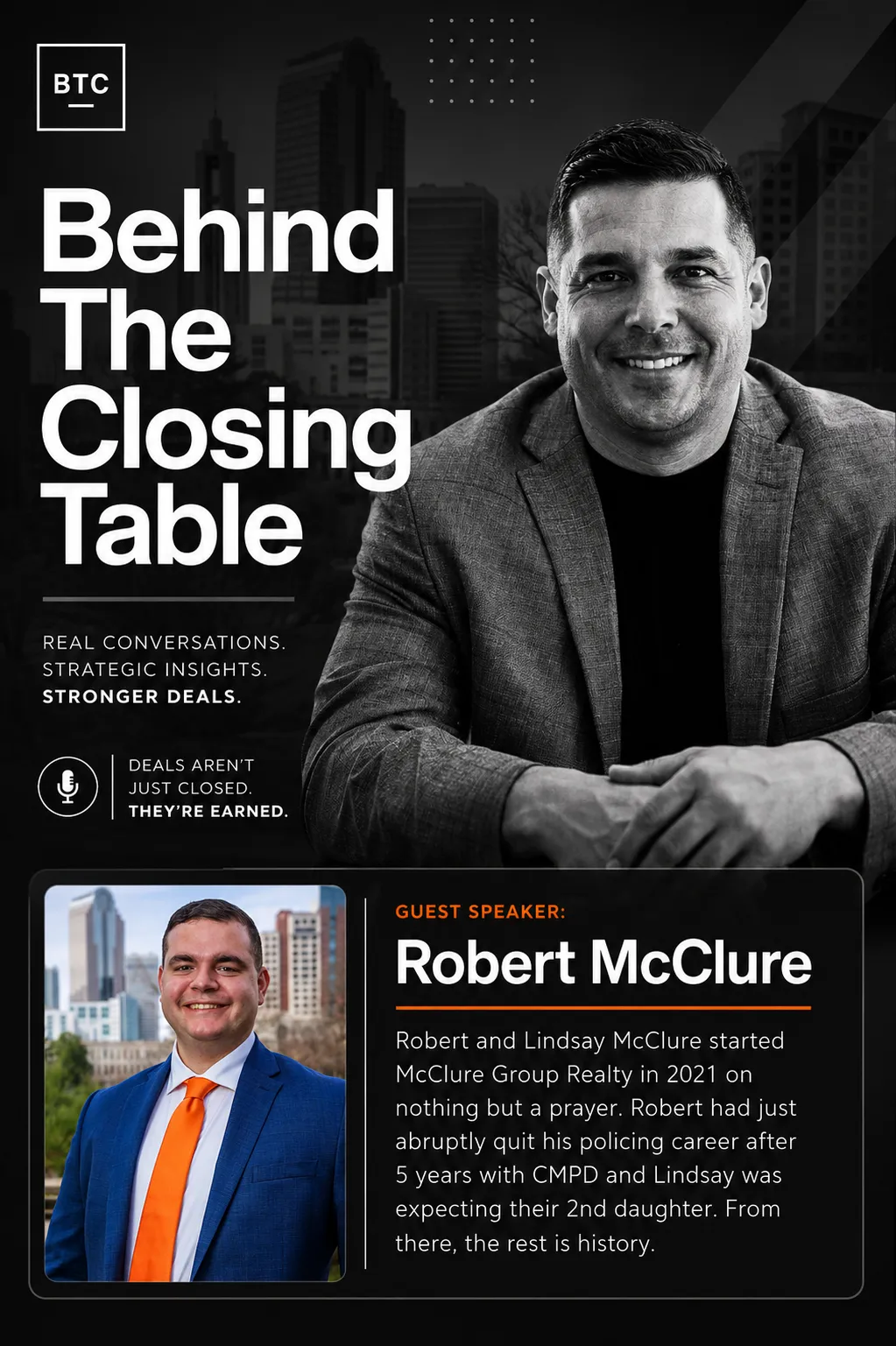
Behind the Closing Table Episode Three: Robert McClure on 165 Transactions and What Real Estate Takes
From the Thin Blue Line to the Top of the Carolinas Real Estate Market
Matt Brady brought Robert McClure of McClure Group Realty onto Behind the Closing Table for a conversation that covers the full arc of a real estate career built on doing the opposite of what everyone else was doing. Robert went from six years with CMPD to becoming the number one agent in North and South Carolina by transactions last year. The path between those two points is worth understanding because it is not the story most people tell about how they got to the top.
How It Started
After sixteen consecutive days of twelve to sixteen hour shifts during the unrest of 2020 Robert nearly missed his oldest child's first birthday. He went to the Outer Banks to reflect and came back with a decision. He would do literally anything else. A partner on his shift mentioned a former colleague who had gotten into real estate and was doing well. The story included a Lamborghini that turned out not to be true but it was enough to get Robert to get his license in April 2021.
He spent the first thirty days trying to find a brokerage that would pay him a salary. That is not really how real estate works. He ended up at EXP and figured out fairly quickly that he was not great at what he was doing but he could be the cheapest. He started flipping FSBOs at one percent commission and sold 57 homes his first year. He went on to lead the number four team in the state at EXP with only six agents and expanded into South Carolina.
Then in year three he made what he describes as the bright and brilliant bad decision to quit EXP and start his own firm with plans to build a hundred and fifty thousand agents and take the world by storm. He got licensed in Tennessee and Georgia, hired sixty agents, and promptly discovered that he had traded freedom for a job again spending forty hours a week managing other people with no time for his own business.
He went back to the single agent model with support staff. He was just named the number one agent in North and South Carolina by number of homes sold last year with a hundred and sixty-five transactions. He has more free time for his now three children including a son who was five weeks old at the time of this recording.
Advice for New Agents
Robert's advice is direct. Hustle and be different. He points out that it has never been easier to stand out because almost every agent and lender looks the same and AI is making that problem worse. When he got into real estate people told him to stay away from FSBOs and never discount his commission. He decided to do both and it was exactly what set him apart.
He avoids copying what other people are doing. When he sees a marketing package or an approach someone else is using he tries to do the complete opposite. That instinct toward differentiation is what has driven his growth at every stage.
On whether new agents should join a team he acknowledges it is a loaded question given how he did it. For most people joining a team makes sense even though you pay more splits and make less money early. The key is to look at whoever is leading that team, see what their production looks like every year, and make sure their ceiling is higher than your goal. If the person you are learning under is not producing at or above what you want to achieve your ceiling is already set.
What Makes MGR Different
Robert acknowledges that Google has told him he is overconfident and overly aggressive. He agrees with both descriptions and tells clients upfront that it is his greatest weakness and his greatest strength simultaneously.
Despite the high transaction volume his team checks in with clients every day. Floor plans are measured. Detailed dollhouse renderings are produced. Four K AI videos get created. Targeted marketing goes out rather than traditional methods. The clients who come in thinking he will be too busy for them consistently end up surprised by how frequently he checks in and by the fact that he is reachable on his personal cell throughout the transaction.
He makes the point that buyers and sellers should not want to be an agent's only client. Economies of scale allow his team to repeat a meticulous process efficiently across many transactions simultaneously and deliver personal attention at scale in a way that a low-volume agent simply cannot.
The Mistakes Buyers and Sellers Keep Making
Robert ties both buyer and seller mistakes back to the same root cause. Being overly emotional because expectations were not set realistically upfront.
On the seller side the mistake is expecting a full price offer with no concessions, no repairs, and no buyer agent compensation in a market that does not support that outcome. On the buyer side it is expecting to acquire a four hundred thousand dollar home for two seventy-five with fifteen thousand in concessions because the market has cooled slightly.
The solution is handling the hard conversation at the beginning rather than at the worst possible moment during the transaction. Tell sellers upfront that an FHA loan may require repairs for an appraisal. Tell buyers that a good deal does not mean stealing the property. Set the expectation and deal with the difficulty early when there is still room to navigate it.
First Time Sellers in a Changed Market
Robert identifies first-time sellers as an underserved and underestimated group. Many of them bought four or five years ago and are now selling at or below what they paid which is genuinely difficult to process emotionally. They also tend to overvalue their improvements. Solar panels, freshly cleaned carpets, a new coat of paint. These things do not translate to twenty or thirty thousand dollars in added value and the conversation about what a buyer will actually pay for the home is sometimes a hard one.
His approach is to help sellers understand that homes are worth what a buyer will pay for them the same as baseball cards and that the first offer received is frequently the best offer they will see. He intentionally keeps disclosures out of the MLS so buyer's agents have to call him which creates an opening to communicate what the seller needs from a deal and set it up to close efficiently.
He also brings a cash offer from one of his hedge buyers to every seller which creates urgency without pressure. The seller knows there is an option available even if they choose to pursue full market exposure.
Renovations That Return Value and Ones That Do Not
Robert's take on what to do before selling is grounded in practicality. Paint the house. Clean or replace carpets. Update flooring. Kitchens tend to return their investment. In-ground pools in good condition add value in the North Carolina market. Good landscaping and a refreshed front door make strong first impressions at low cost. Replacing old windows produces solid ROI. Keeping up with roof maintenance prevents the thirty or thirty-five year old roof from becoming a negotiating problem at the worst possible moment.
Solar panels are a different story. He thinks people are finally accepting that buyers do not want to take over a solar loan and the sellers who installed panels are going to take a loss on that investment when they sell. The general principle is that maintenance and upkeep over time is worth far more at closing than last-minute renovations attempted right before listing.
Hidden Gems in the Carolinas
Robert is cautious about letting secrets out given how many people are already moving to the Carolinas. He notes that beach properties are performing well again after a period of concern about turnover and erosion. Western Carolina used to be the hidden gem but Helene changed the appetite for that market. The Triad of Winston-Salem, the Yadkin Valley, and Greensboro is consistently underrated given how accessible both Charlotte and Raleigh are from those areas.
In South Carolina he is seeing investment interest move beyond Myrtle Beach into Hilton Head, Beaufort, and the islands further south as HOA fee increases in the condo-heavy Myrtle Beach market make those areas relatively more attractive.
How to Evaluate an Agent
Robert recommends pulling receipts rather than accepting Instagram or Facebook as evidence of success. Selling Sunset and similar shows have made it easy to appear successful and the platforms that agents use to market themselves are not a reliable indicator of what they actually produce.
He invites direct comparison. Give him another agent's name and he will show the client what both of them have done in the last twelve months including days on market, sale price relative to list price, number of transactions, and where those transactions occurred. His team averages 104 to 108 percent of market value which speaks for itself against any comparison.
He also emphasizes that the contact network an agent has built matters significantly. Four or five lending contacts. Four or five attorneys. Knowledge of creative financing options including subject-to and seller financing. Investor relationships. Off-market access. An agent who has worked with one lender and one attorney for thirty years cannot serve the range of client situations that the market produces.
The Myth That Still Bugs Him
The persistent belief that agents do not deserve their commission because all they do is put a sign in the yard and say a prayer. He acknowledges that for some agents that might actually be accurate. For the ones doing a hundred and sixty-five transactions a year that is not the business model.
He draws a parallel to law enforcement. The best officers are the ones who handle situations smoothly enough that nobody realizes how much effort went into keeping things from escalating. The same is true in real estate. A client who goes through a full transaction and only hears from him two or three times for important updates does not mean nothing was happening. It means a lot was happening that did not need to become the client's problem.
What He Wants Clients to Remember
Robert wants every buyer and seller to feel like they won something when they walk away from the closing table. Not that they have made a best friend and not that they dealt with a cold machine but that they are a fan of the process and feel good about the outcome. That feeling is what produces repeat business and referrals not just a transaction that closed on time.
Goals and Life Outside Real Estate
He does not set a specific transaction goal. He just does not like going backwards. A hundred and sixty-five last year means he needs to beat a hundred and sixty-five this year and the path to doing that is efficiency not grinding harder.
Outside of work Robert is a Disney family making annual trips to the parks. His family goes to the beach regularly given that his wife's mom is in Myrtle Beach. He takes his two older daughters to movies in the summer heat and they just saw Toy Story Five. There is a farm involved and fishing and anything outdoors. And a five-week-old son at home means the schedule is currently adjusted accordingly.
How to Reach Robert McClure
Google his name or McClure Group Realty and the team comes up consistently. McClureGroupRealty.com or McClure Group Realty on Instagram and Facebook.
Matt Brady at Success Lending is the lending partner behind every deal. Behind the Closing Table continues with more conversations from the people who make real estate transactions happen. Have a great day.
Sources
NorthCarolinaRealtors.com
SouthCarolinaRealtors.com
NAR.realtor
MortgageNewsDaily.com
Realtor.com
