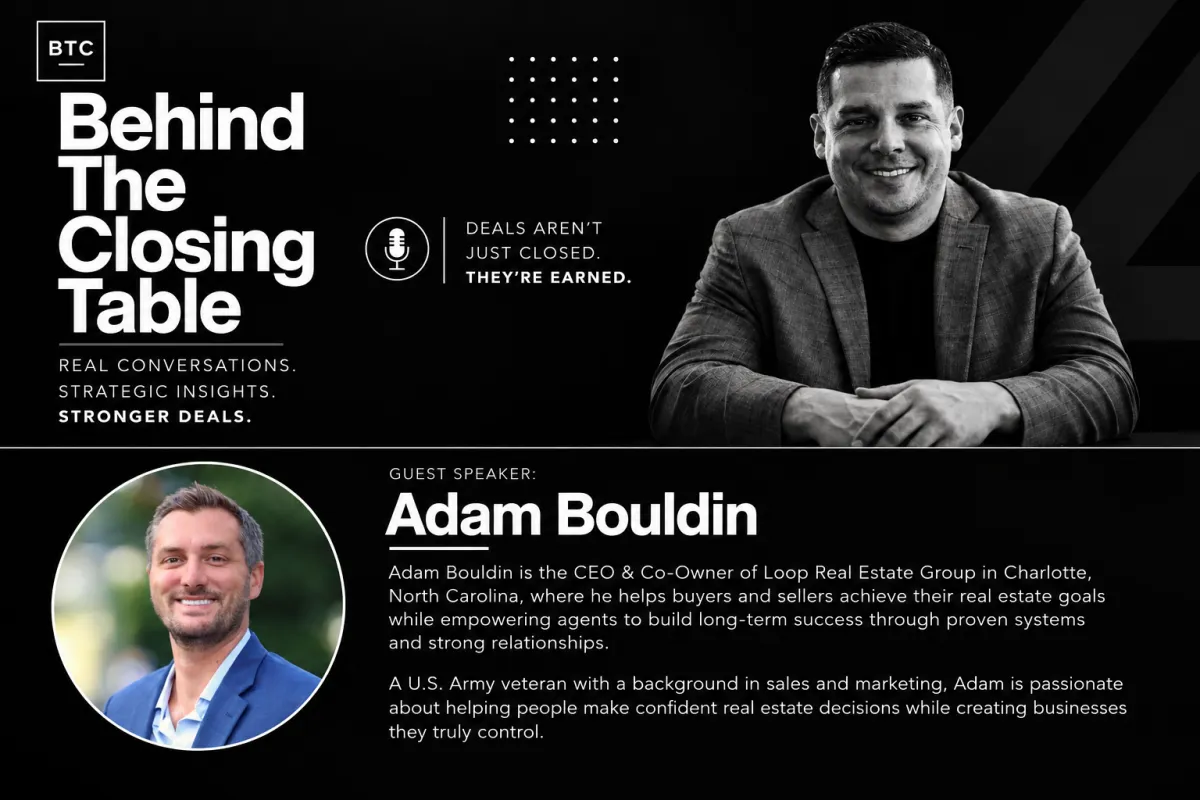
Behind the Closing Table: Matt Brady Talks Agent Coaching and Charlotte Market With Adam Bouldin of Loop
The Agent Who Built a Real Estate Business by Getting Destroyed on the Phone First
Matt Brady sat down with Adam Bouldin of Loop Real Estate in Charlotte for a Behind the Closing Table conversation that covers how to actually build a real estate career, what separates agents who make it from the majority who do not, what the Charlotte market looks like right now, and why the brokerage name on your business card matters almost not at all.
Adam is originally from Greenville, North Carolina, the right Greenville as he puts it. He joined the army out of high school, traveled the country doing sales work for AT&T affiliated companies, and eventually decided he wanted to invest in real estate. He called a friend to ask how to get started. His friend started rattling off terms and concepts Adam had never heard. He realized that if he was going to invest in real estate he should probably understand what his friend was talking about. He got his license. Then figured he might as well sell a house while he was at it. The rest developed from there.
What Real Estate Actually Looks Like Versus What Everyone Thinks
Adam speaks at Superior School of Real Estate in Charlotte regularly and he sees the same mentality in every incoming class that he had when he started. Selling Sunset. HGTV. Easy money and beautiful homes. The reality is that eighty-seven percent of agents do not make it past three to five years. He knows this and he says it out loud because he thinks people should hear it before they invest their time and money rather than after.
He is glad the business is hard. It should be hard. The ones who stay are the ones who can handle that.
How He Built His Business in the Beginning
His first client came from Zillow. The early business was built on internet leads, open houses, and cold calling a list of a couple hundred people who tore him apart. He would get a question he could not answer, the person would hang up, and he would write the question down and learn how to answer it before the next call. Those calls shaped how he wanted to build his real estate career. They were uncomfortable and they were exactly what he needed.
He had a lot of good mentors in those early years. Rather than copying one of them entirely he took pieces from each, the things that resonated with how he naturally operated, and built something that felt organic to him. He is direct that you cannot dive into real estate part-time. You have to go all in.
The referral flywheel took longer than he expected. About two and a half years before past clients were generating meaningful referrals. Looking back his biggest regret from the early days is not building his database more intentionally from day one. His view now is that the database is the single most profitable and scalable asset in a real estate business. When you are new you do not have one and that means there is no better time to start building it because the cost of maintaining it is low when the list is small.
Are Internet Leads Garbage or Are Most Agents Just Bad at Working Them?
Both things are partially true is essentially Adam's answer. Zillow leads are notably hotter than most internet leads and there is a reason Zillow takes forty percent of the referral fee on conversions. But even with the best lead source in the world calling once and moving on is how most agents fail to convert. He wants someone to tell him to go away and stop calling before he actually stops. Until that happens he keeps following up.
His conversion expectation from a cold internet lead pool is two or three percent for generic leads and around ten percent for Zillow specifically. His objective on the first phone call is simple. Get the appointment. That is it. Build the rapport in person where he knows he can close the deal. On the phone just get to the appointment as quickly as possible.
He also made a point about the long-term value of internet leads that most agents miss. Do not evaluate a lead purely on the transaction. Evaluate it on the network behind that person. Their cousins, their coworkers, their bartenders, their barbers. Every internet lead that closes has a sphere attached to it and that sphere is what you are really building when you convert them.
The Gap Between Getting Your License and Getting Your First Deal
Two years into his career Adam recognized that there was a significant gap between what real estate school teaches and what an agent actually needs to know when they show up on Monday morning and have to figure out what to do. Post licensing requirements in North Carolina exist to help fill that gap but they do not cover practical day-to-day operations in any meaningful way.
He and his partner Matt Burroughs built a boot camp specifically to address that gap. The reason it works is that when they built it they were still close enough to the experience of being brand new that they knew exactly what was going on in the minds of people coming out of real estate school. The content is practical rather than theoretical. It is not a legacy training program built on twenty-year-old market assumptions. It updates as the market updates because what Adam is teaching agents today is materially different from what he was teaching two months ago.
The agents who get the most out of the coaching are not the ones who watch the videos and attend the sessions and wait for results. They are the ones who call Adam out of nowhere to ask what he is doing this week and whether they can shadow a showing or watch him write a contract. That level of engagement is what separates rapid results from slow ones.
Work ethic, he says, absolutely overcomes natural sales ability. But the single most important trait a real estate agent can have is availability. Show up for yourself. Show up for your clients. Show up for your business. Things happen when you show up.
How Loop Real Estate Got Its Name
Adam's partner John Whitafi came up with the name after weeks of discussions trying to find something that did not sound like every other real estate company. They wanted one word. Easy to brand. Something that was not foundation something or new home realty.
The four-eighty-five belt loop around Charlotte was the inspiration. Loop. Brandable. You can keep someone in the loop. Loop program. Loop anything. What they did not realize until after they launched was how many times the word loop appears in ordinary daily conversation without anyone thinking about it. It is in the name every day without any effort.
What a Brand Is Versus What a Logo Is
The Loop team runs two social media days per month for their agents. They bring everyone to a property, usually a strong listing or a new construction home, and the director of brand growth Sean Hammeker has all the content planned and all the equipment set up. Gimbals, microphones, prepared video concepts. Agents shoot video walkthroughs, educational content, and occasionally comedy videos that Adam says are genuinely funny and worth checking out on their Instagram.
His broader point about personal branding is one worth sitting with. Nobody cares about the brokerage. When Adam switched companies he called his clients to let them know and their first question was whether he had left real estate entirely. When he told them he had just switched firms the universal response was some version of I do not care about that. They cared about him. Not the name behind him.
That is why personal brand is what matters. Educational content. Funny content. Niche-specific content built around something authentic to who the agent actually is. Whatever makes someone feel like they know you before they ever call you is the brand worth building.
The Charlotte Market in 2026
Adam has been in Charlotte since 2016 and has watched it transform from a place where uptown was the center of gravity to a city defined by neighborhoods. Plaza Midwood. NoDa. SouthEnd. Ballantyne. Fort Mill. Lake Wiley. Denver on the lake side that he calls underrated in the broader Charlotte conversation. The rate of people moving to the area, somewhere around eighty a day, is something you can feel on the roads and in the apartment and townhome construction that seems to be going up everywhere.
New York and Florida are the two dominant states sending people to North Carolina right now. The draw is consistent. Mountains ninety minutes away. Beach three hours away. Major airport with direct flights everywhere. Two months of potential snow and two months of genuinely hot summers with everything else being beautiful. And unlike some coastal cities that feel like they have one personality Charlotte has neighborhoods with enough variety that almost anyone can find their vibe.
For buyers coming from out of town Adam's first questions go to current situation before anything else. Are they renting? When does the lease end? What does it cost to break it? Do they need to sell something first? What is the cash picture for the actual closing rather than just the purchase price? He frames the decision the same way a good lender does. What do you need in the next thirty days to close this house and what does the monthly payment look like after that? Those are the only two numbers that actually matter.
North Carolina Versus South Carolina for Buyers
He is licensed in both states and sells in both markets. His most direct piece of advice about the South Carolina side is simple. Do not buy an investment property in South Carolina unless you are fully prepared for the property tax implications. The jump from primary residence tax treatment to investment property tax treatment is significant and catches buyers off guard consistently.
Beyond that the choice between the two states is a lifestyle question. Lake access, school districts, proximity to employment, how much rural versus urban appeals to the buyer. Both have strong markets and both have neighborhoods that are still developing in ways that create opportunity for buyers who are willing to look slightly beyond the most obvious choices.
What Separates Great Agents in 2026
The biggest shift Adam identifies in what it takes to succeed right now versus when he started is the need for genuine market knowledge that is current rather than general. The market changes month to month and sometimes faster than that. An agent working off of assumptions built in a 2021 or 2022 market is going to give clients advice that does not match current reality.
On the listing side you cannot just put something on the MLS anymore and wait. Preparation matters. Pricing strategy matters. Understanding what else is available in the neighborhood at the same time matters. He described his last two listings where the next-door neighbor listed simultaneously and the first thing he did was call that agent to make sure they were not accidentally undermining each other's negotiations. That kind of proactive situational awareness is what separates professionals from people with a license.
He also thinks it is harder to get started now than it was during COVID even though COVID-era buyers had to submit six or eight offers before winning anything. The reason is simple. During COVID there were buyers everywhere. Even if you did not close many deals you were constantly in front of people. Right now finding the client is the hard part.
What Lenders Need to Be to Work With Adam
Availability. Same word he uses for agents. The ability to be reached on a Saturday evening during football, to answer a question you do not immediately know the answer to by connecting the client to someone who does within twenty minutes, and to follow through on whatever you said you would do. He is not asking for perfection. He is asking for presence and responsiveness.
What He Wants Clients to Remember
If there were no surprises he did his job right. Everything that could happen was put on the table in advance. Expectations were set across all three scenarios, best case, most likely, and worst case. The client knew what they were walking into before they signed anything. If all of that happened and they walked away from the closing table feeling like the experience was smooth and predictable then Adam considers the job done correctly.
How to Reach Adam Bouldin and Loop Real Estate
Loop Real Estate's contact information is in the caption and description. Adam is actively adding agents at all experience levels and is available for conversations about joining the team, going through the boot camp, or simply learning more about how they operate. He and his partners describe themselves as stewards of transparency. They will show anyone the blueprint including the mistakes.
Matt Brady is the Carolina Mortgage Coach. For mortgage guidance on your next Charlotte area purchase reach out to Matt Brady directly.
Sources
CharlotteRegionalRealtorsAssociation.com
NAR.realtor
MortgageNewsDaily.com
ConsumerFinancialProtectionBureau.gov
Investopedia.com
