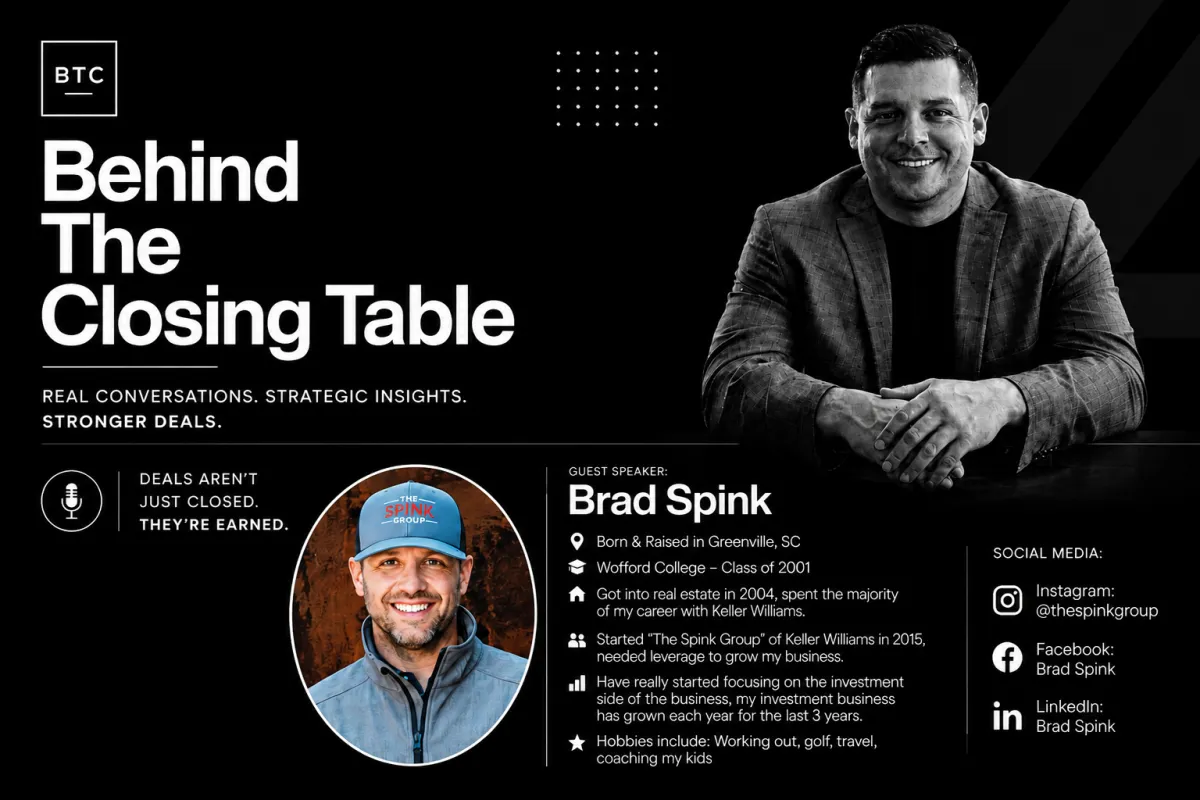
Behind the Closing Table With Brad Spink: From Greenville Roots to Fix and Flip Buy Box Mastery
Meta Description
20 years in Greenville real estate, team leader and investor. Matt Brady talks persistence and investing with Brad.
Behind the Closing Table With Brad Spink: From Greenville Roots to Fix and Flip Buy Box Mastery
A Twenty-Year Career Built on Persistence Problem Solving and Learning From the Deals That Went Sideways
Matt Brady sat down with Brad Spink of the Spink Group with KW Realty in Greenville for a Behind the Closing Table conversation that covered two decades of real estate, what separates agents who last from those who flame out, how to price listings in a changed market, and the specific buy box framework that turned a series of investment mistakes into a repeatable and profitable system.
Brad and Matt go back years. Old gym buddies before Brad moved to the Greenville area. The connection held and the conversation reflects the kind of directness that comes from two people who actually know each other.
How Brad Got Into Real Estate
Brad is Greenville born and raised. He went to Wofford and became friends in college with a classmate who was already buying rental properties at 21 and 22 years old. That exposure planted the idea that real estate could be something worth pursuing even if Brad never initially imagined it as a career.
In 2004 a job change created the opening and Brad made the move into real estate sales. It was a good market and the forgiving environment of 2004 through 2006 let him find his footing while still earning. In 2010 he moved into a Keller Williams leadership role overseeing offices for about five years before returning to the sales side in mid-2015 to build his own team. That team has been his primary focus for the last eleven or twelve years and the knowledge accumulated across all three phases of his career continues to inform how he operates.
What Separates Agents Who Last From Those Who Flame Out
Brad's answer is persistence and it is more specific than the word usually implies.
Getting a house under contract is not the hard part. Getting it to the closing table is the challenge. And the ability to problem solve when things come up during a transaction, to follow up with a lead for the eighth or ninth or tenth time, to work constructively with the agent on the other side even when the transaction is creating friction, those are the skills that determine whether someone builds a real career or exits within the first couple of years.
He gives himself twenty-four hours to be frustrated when a deal falls apart after significant time and effort. Then it is time to move on. That ability to reset without carrying the weight of a failed transaction into the next week is part of what has made his career sustainable over two decades that included a financial crisis, a pandemic market, and the current high-rate environment.
Matt added a point Brad reinforced strongly. Setting expectations proactively throughout the transaction is one of the most underrated skills in the business. First-time buyers who receive a forty-page home inspection report without prior context believe the house is collapsing. Agents who have not had that conversation in advance create anxiety that does not need to exist. The conditional loan approval process, buyer's remorse after going under contract, the emotional complexity of selling a home filled with family memories. All of it needs to be anticipated and addressed before it arrives.
What Brad Tells Buyers and Sellers Right Now
For buyers the message is that more inventory exists than has been available in recent years and that creates real options. The rate environment is not ideal but it is addressable. Negotiating seller contributions toward a buydown can reduce the payment meaningfully without the buyer having to wait for market conditions to change. And new construction in the Greenville area is currently offering incentives including rates as low as 4.99 percent on finished homes, full closing cost coverage, and appliance packages that buyers are simply not going to match on the resale side.
For sellers the pricing conversation has shifted. Brad is not using sold comps from nine or twelve months ago as the primary pricing anchor because that was a different market. He is pricing against active competition. What are the similar homes currently on the market, what are they priced at, and how long have they been sitting? Where does this home need to be to become the next one that sells rather than another listing collecting days on market?
He prices within search parameters rather than at arbitrary numbers. A home worth somewhere in the upper four hundreds gets listed at five hundred because that is where buyers searching online find it. And he negotiates built-in price reductions with sellers before going to market so that if the activity metrics are not there by day fourteen the next step is already agreed on rather than requiring a difficult conversation from scratch.
How to Handle a Pricing Disagreement With a Seller
For newer agents who do not yet have the confidence to hold firm on pricing Brad's framework is collaborative and practical. He does not tell sellers this is the number. He presents the data and says here is what the numbers show, I am comfortable in this range, what would you like to do together.
If the seller wants to start higher than he would recommend he accepts that rather than walking away from the listing. He then gets agreement on day fourteen. If there has not been a defined level of showing activity or an offer by that point they already have an agreed-upon price reduction in place. The seller gets to start at their number. Brad gets the price reduction conversation already handled before it becomes a source of conflict. Both parties know what is coming and the expectation was set before it was needed.
The Investment Side: Buy Box Discipline and the Grandma Friendly Street Test
Brad teaches an intro to real estate investments class and the concept he leads with is developing your buy box before you start buying. He arrived at his buy box through a series of lessons including a deal he worked on for six months and walked away from with five hundred dollars.
His criteria are now specific and non-negotiable. Three bedroom two bath homes between approximately eleven hundred and seventeen hundred square feet. What he calls grandma-friendly streets. Would he feel comfortable with his grandmother or his mother or his sister living on that block? And no eyesores. He made the mistake of renovating a home that turned out beautifully that sat next door to a single wide that needed demolition and across from a vacant lot full of rusted tractors. The renovation quality was not the problem. The surrounding context was the problem and it was a problem he could not solve.
His postcard marketing campaigns are now easy to execute because the buy box is precise. He can filter his target list to exactly the types of homes in exactly the types of locations that fit his criteria and avoid wasting marketing spend on properties he would not buy anyway.
Fix and Flip Versus Buy and Hold
Brad's view is that buy and hold is the more complicated of the two strategies particularly in South Carolina where investment property tax rates can be two and a half times what a primary residence owner pays on a comparable home. That tax difference is a real cash flow obstacle that many new investors do not fully account for before purchasing.
He does not dismiss buy and hold but he is specific about what makes it work. The more sophisticated investors pursuing rentals are often primarily interested in cost segregation, the ability to take the majority of a property's depreciation in year one rather than spreading it over the standard twenty-seven and a half year schedule. The tax advantages of that structure can make a property that does not cash flow on a monthly basis still make financial sense. For investors who are not working with a tax advisor who understands cost segregation and who are evaluating rental properties purely on monthly cash flow the math is often less attractive than it appears at first.
For new investors fix and flip is the more accessible starting point. The cycle is defined, the outcome is measurable, and the learning per deal is concentrated and fast.
What to Actually Spend Money on When Flipping
One of the most consistent mistakes first-time fix and flip investors make is over-updating the property for the buyer they are targeting. A buyer purchasing at two hundred twenty-five thousand does not expect level three granite. They are not walking in hoping for hardwood floors throughout. High-end fixtures and premium appliances are not what drives their buying decision.
Understanding who the buyer is at the target price point and updating accordingly is what separates profitable flips from projects that eat their own margin. Spending more than the buyer at that price range will value is not a renovation strategy. It is a way to reduce your own return without improving your result.
The Value of a Trusted Contractor and What That Relationship Actually Looks Like
Brad spent years acting as his own general contractor. He is not handy. What he could do was show up, check on progress, make multiple trips per week to each project, and manage the sequence of subcontractors to keep things moving. It was effective but it consumed enormous amounts of time.
Finding a contractor he trusted enough to hand over project management changed everything. He now meets the contractor at the property once, walks the project together, gets a quote that night, and makes approximately two trips to the site during the entire renovation instead of fifteen. He pays three to four thousand more per project for that management and gets his time back entirely in return.
The relationship also comes with financial flexibility. When a project budget is tight his contractor has offered to defer a portion of his payment to the back end of the sale rather than holding Brad to a number that does not work. That kind of long-term thinking from a trade partner is worth more than saving a small amount upfront by working with someone who does not have a stake in the ongoing relationship.
His advice for finding those relationships starts at local real estate investor groups. Go to the meetings. Meet the experienced investors. Come in with humility and ask for recommendations. Who does your painting? Who does your roofing at reasonable pricing? What you are building is volume relationships where the contractors understand they are not doing one job for you. They are doing six or eight a year and they price accordingly.
A New Investment Type Worth Knowing About
Brad recently bought a 1.7-acre rural lot intending to flip it quickly to a buyer he had worked with before. That buyer was too busy with existing projects to take it. Rather than being stuck Brad ended up learning an entirely new investment type. He bought a brand new mobile home from the same contact, used the contact's entire subcontractor network to complete the installation, and had the property under contract shortly after listing. The network he inherited for that first project made the process run smoothly and opened a new category of investment he had never explored before.
Plan B created the next skill set.
What Brad Hopes Clients Remember
Brad's answer on what clients should take away from working with him comes down to two things. That the process was made enjoyable rather than stressful even when things came up that could have caused anxiety. And that his clients always knew he was looking out for their interest rather than his own.
His philosophy from day one has been that he will never make decisions in a transaction based on what benefits him. Every decision is made based on what benefits the client most. That is not a tagline. It is a consistent operating principle that has driven two decades of repeat business and referrals in the Greenville market.
Find Brad Spink and the Spink Group on Facebook and Instagram and watch for the new website launching soon. All contact information is included in the caption of this episode.
Matt Brady at Success Lending is the mortgage partner behind every deal. Behind the Closing Table continues with more conversations from the people making real estate work across the Carolinas. Have a great day everyone.
Sources
GreaterGreenvilleAssociationofRealtors.com
NAR.realtor
MortgageNewsDaily.com
BiggerPockets.com
Investopedia.com
