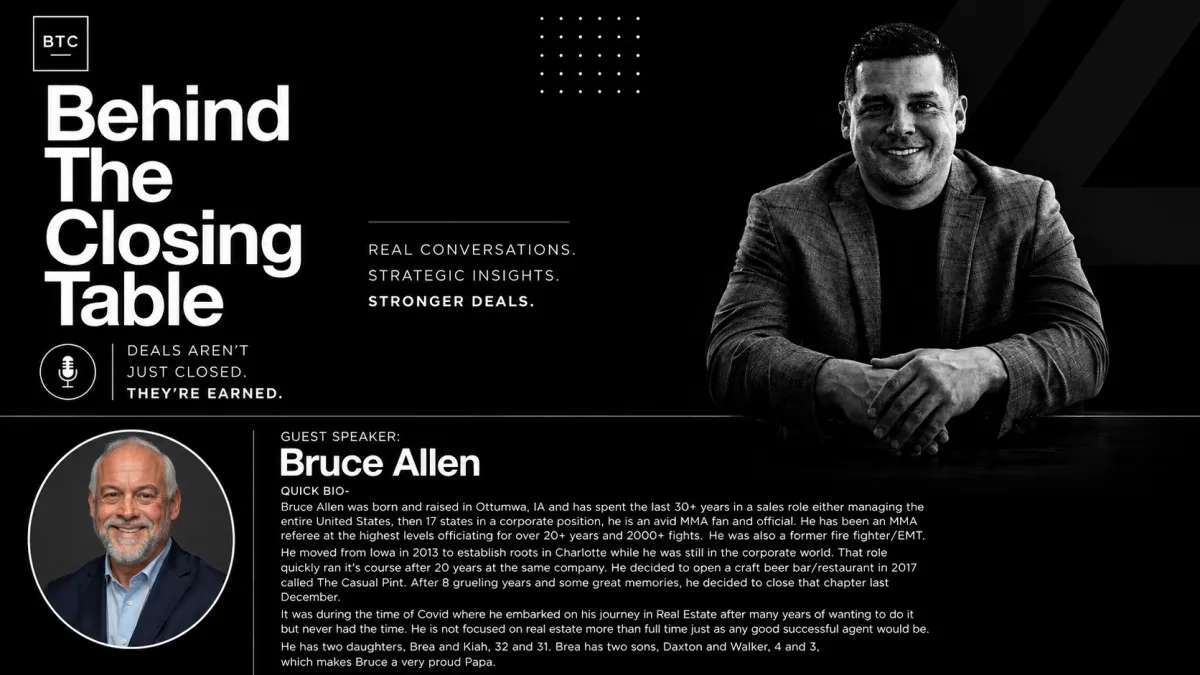
Behind the Closing Table With Bruce Allen: UFC Ref Craft Beer Veteran and Straight Shooting Realtor
A Sales Career That Went From Corporate to Craft Beer to the Octagon to the Closing Table
Matt Brady sat down with Bruce Allen of EXP and the Signature Group for a Behind the Closing Table episode that covers a career path unlike any other on the podcast. Corporate sales. Craft beer bar owner for eight years. Twenty-plus years officiating mixed martial arts at the highest levels with over two thousand fights refereed. A firefighter background that he and Matt share. And now a real estate career built on the same principles that carried him through all of it.
Bruce Allen is from Iowa. He drives a truck. He shows up to appointments in a polo shirt and considers that a feature not a bug. The pretense-free approach to real estate that his background produces is exactly what his clients describe when they talk about working with him.
The Path That Led to Real Estate
Bruce spent his adult life in high-volume, high-price corporate sales before burning out and deciding to bet on himself. He opened a craft beer bar and restaurant and ran it for over eight years. He describes the craft beer business as not for the faint of heart, which is saying something coming from a man who has been standing in the middle of professional fights for two decades. He closed the bar in December of 2025 and describes the weight lifting as a fresh start.
He came to Charlotte in 2013 and put down roots. He started in real estate at a boutique firm called Patel Standard Realty where he learned the hard way what solo agent life actually costs in time, money, and persistence. He paid approximately fifteen hundred dollars a month for Zillow leads in the early days just to keep the pipeline moving. Eventually he moved to EXP and joined the Signature Group around three years ago as one of the first members. He does not envision leaving.
He also still travels wherever he is needed to officiate MMA fights. The octagon and the closing table occupy the same week some months.
What New Agents Underestimate About This Business
Bruce is direct about the gap between what people expect when they get their license and what the business actually looks like.
They come out of school thinking they will make a lot of money right away. They will not. You are building a business from the ground up. The costs hit immediately. Board fees, MLS fees, marketing, technology, leads. Everyone has their hand out and none of it is cheap. And then the first closing is still thirty to forty-five days away from turning into a paycheck.
He echoes what Matt reinforced from the lending side. The foundation you are building right now is your paycheck in November and December. The agents who flame out are almost always the ones who get deals under contract and then stop doing the activities that got those deals. The contract requires attention. The pipeline requires the same activities that filled it in the first place. Stopping those activities during a busy period creates the valleys that follow every peak.
Bruce's solution for new agents is simple. Find a good team to get on. Let them feed you leads while you build your sphere organically. You pay with splits but you avoid the enormous upfront cost of buying your own leads and you get the reps and relationships that build the business long term.
He is in the EXP mentor program and coaches new agents himself. His guidance to them on open houses is consistent. It may or may not sell the house but it is essential practice. You have to get used to being uncomfortable in this business. Picking up the phone and calling people who do not want to hear from you. Standing in a house talking to strangers. Getting the nos out of the way so you can get to the yeses. That discomfort is non-negotiable and the sooner a new agent accepts it the better their odds of making it through year one.
How Bruce Leads Buyer and Seller Conversations in This Market
The biggest objection Bruce deals with consistently from buyers is the rate conversation. They want to wait until rates come back down to COVID levels. He is direct about why that is not a realistic strategy. We will be lucky to see four percent again in his view and the Charlotte metro is one of the hottest markets in the country with over 130 people a day moving into the area. Every day a buyer waits for rates to fall is a day house prices are moving in the other direction.
His framing is the same one that consistently makes sense in the current environment. Finance now at today's rate. Negotiate a buydown to make the payment work. Get into the house. Refinance when rates come down. Be ahead of the curve when prices jump again rather than competing against the flood of returning buyers who all decided to act at the same moment.
On the seller side he starts with the truth about pricing. Every seller thinks their house is worth more than the market says it is. That is not unique to any market or any price point. Emotions and memories attach to homes in ways that make objective pricing feel like an attack on something personal.
His approach is to go in with facts and be a straight shooter. He tells clients upfront that if they want to be told what they want to hear he is not the agent for them. He is going to tell them what will actually get the deal to the closing table and it is their choice whether to listen. He knows the house will eventually show them through data if the price is wrong. No activity in two weeks is a clearer argument than any presentation.
He also describes the therapist dimension of the job without irony. He has been on the phone at three in the morning talking someone through a moment of panic. A husband has told him thank God for you, you saved my marriage. The job is not just contracts and negotiations. It is emotional intelligence applied to one of the most stressful decisions people make.
How He Handles Inspections With First-Time Buyers
The inspection report is one of the most consistent sources of first-time buyer panic and Bruce has a specific process for managing it. He coaches clients before the report arrives. There will be a lot of items in this report that appear in ninety-five percent of all other inspection reports and are not a big deal. Let him review it first. Then they will go through it together with him directing attention toward the items that matter and away from the leaky faucet and the door that does not close right and the fire seal on the electrical box.
He makes the inspector's obligation clear to clients. The inspector has liability coverage and must document everything he observes. That is why the report is fifty to seventy pages. It does not mean the house is falling apart. It means the inspector is doing his job correctly.
He also likes the inspection period. He is a negotiator by instinct and the inspection is a second round of negotiation. He approaches it as an opportunity and looks forward to it rather than treating it as a potential deal-killer.
The Seller Credit Conversation Worth Having
Bruce covers the seller credit versus price reduction distinction with his buyers and explains it in terms that shift how first-time buyers think about what they are negotiating for.
Ten thousand dollars out of your own pocket at closing hits harder than ten thousand dollars off the list price. A seller credit is actual cash that is not coming out of the buyer's hands or that can be directed toward buying down the rate. That is more valuable in most cases than the monthly payment reduction that comes from the equivalent price cut.
He has had buyers walk out of closing with a check in hand rather than writing one. He considers that a measure of how well the negotiation was structured. Most of his veterans specifically leave with money rather than bringing it.
On VA loans specifically he makes a point worth knowing. The VA loan is one of the only products that allows seller credits to be applied toward paying off the buyer's debt. That flexibility is underutilized and significantly underappreciated. He tells his veteran buyers the credit is theirs to direct wherever it does the most good.
Myth or Fact: Bruce's Quick Answers
You need twenty percent down. Myth. Spring is always the best time to sell. Myth. December is also a strong time because buyers want to be settled before the holidays. Should you wait for rates to drop. Absolutely not. Should you renovate before selling. Situational. Simple improvements like paint and flooring make a significant difference. Gut renovations are a different conversation entirely. Open houses sell homes. Agent dependent. Bruce personally has had poor results but coaches new agents to do them for the practice and the contacts. The highest offer is always the best. Myth.
What Bruce Wants Clients to Remember
He wants clients to leave the closing table with one feeling above everything else. That he became a friend and not a pushy salesperson. He will not shove a house down someone's throat. He will not show four homes and demand a decision. He will show up in a polo shirt and a truck no matter the price point because that is who he is and clients can see through everything else.
He is friends with a number of his past clients. He expects housewarming party invitations. The closing table is not the end of the relationship. It is a checkpoint.
Sales is relationship building. That is the principle he has taken from every career he has had and it is the one that has outlasted all of them.
Matt Brady at Success Lending is the mortgage partner behind every deal. Behind the Closing Table continues with more conversations from the people making real estate happen across the Carolinas and beyond. Have a great day everyone.
Sources
CharlotteRegionalRealtors.com
NAR.realtor
MortgageNewsDaily.com
NorthCarolinaRealtors.com
Investopedia.com
