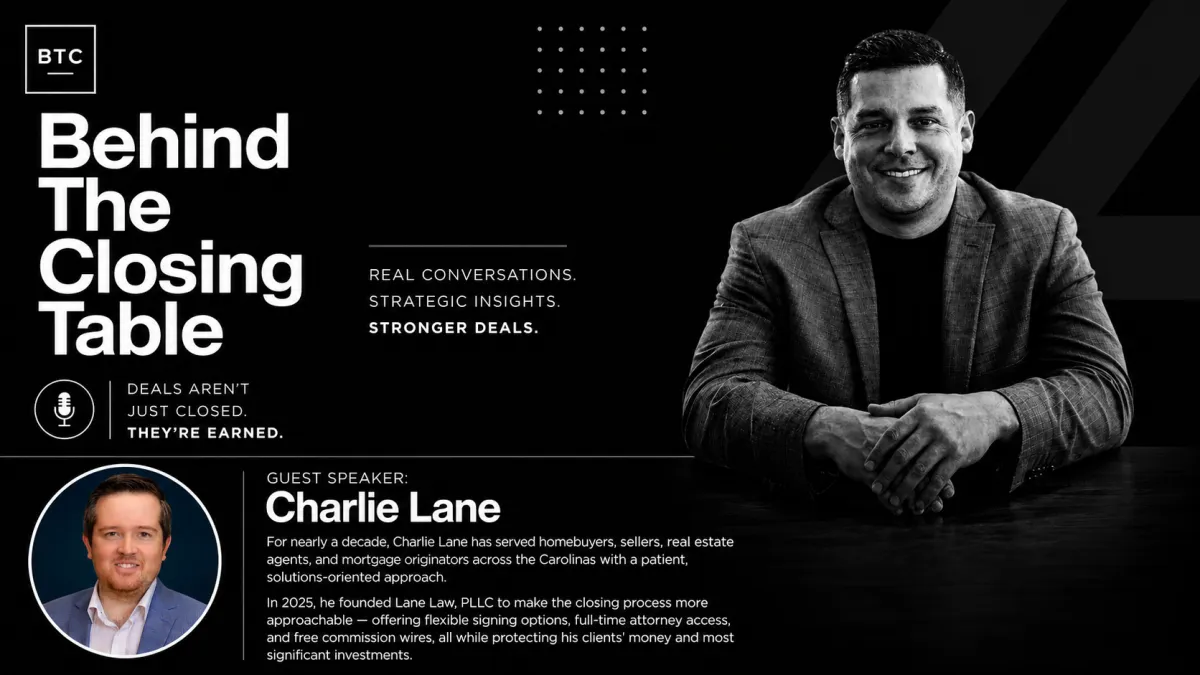
Behind the Closing Table With Charlie Lane: What a Closing Attorney Actually Does and Why It Matters
The First Closing Attorney on Behind the Closing Table and the Conversation Every Buyer Needs to Hear
Matt Brady sat down with Charlie Lane of Lane Law PLLC in Charlotte for a Behind the Closing Table episode that covers territory the podcast has not explored before. What does a closing attorney actually do? What is title insurance and do you really need it? What causes most closings to fall apart at the last minute? And why does the Carolinas' attorney-based closing model protect buyers in ways that title company states simply do not?
Charlie opened Lane Law in April of 2025. He is the owner, the attorney, the paralegal, the marketer, and as he puts it, the janitor. He has been practicing real estate law since 2018 and law since 2015. His path to real estate law was not planned. He hated real property class in law school. What changed him was the logic of title examination, the detective work of tracing land through decades of ownership, researching old family farmland, piecing together tax maps, and building a picture of how property has changed hands over time. That analytical satisfaction became the foundation of a specialized practice.
What a Closing Attorney Actually Does
Charlie describes the closing attorney's two most critical functions as the title and the money. Everything else flows from those two things.
On the title side the job is making sure buyers get what they think they are buying. The right house. The right amount of land. No hidden mortgage. No judgment. No lien that the buyer would inherit unknowingly. That requires searching county register of deeds records, tax records, court records for judgments, HOA records, and anything in the name of the sellers or anyone who has previously owned the property.
On the money side the job is getting funds from where they need to come from to where they need to go. The seller's mortgage gets paid off. HOA dues get prorated. The buyer's closing costs come in. The lender's funds arrive. The inspector's invoice gets processed. The closing disclosure is the document that brings all of those numbers together into a single authoritative record that everyone signs off on before any money moves.
Charlie holds all of that money in a trust account until the lender gives the green light and then executes the disbursements. Millions of dollars move through that account every month and the responsibility of getting every dollar to the right place is not something he takes lightly.
The Wire Fraud Conversation Every Buyer Needs to Have
The Charlotte real estate community has had a visible and painful education on what happens when closing funds end up in the wrong hands. Charlie does not dwell on specifics but the point is clear. Wire fraud is real, it targets real estate transactions specifically because of the large amounts of money involved, and protection requires active vigilance from everyone in the transaction.
His guidance is straightforward. Do not call the phone number from the email when verifying wire instructions. Call the number from the firm's website. Do not send wire information by email without verbal confirmation. Call the closing attorney and confirm the instructions over the phone before initiating any transfer.
Matt reinforced this from the lending side. The money is not going to the lender. It goes to the closing attorney. Buyers who are unclear on that distinction are more vulnerable to the kind of social engineering that intercepts transactions at the last moment.
Title Insurance: What It Is and Why the Incremental Cost Makes No Sense to Skip
Charlie is a genuine advocate for owner's title insurance and he is direct about the fact that he does not make extra money by recommending it. His position is based on what he has seen happen to people who did not have it.
Homeowners insurance protects against physical damage to the house. Title insurance protects against anything that would threaten your ownership rights. Hidden liens. Undisclosed judgments. Forged documents in the chain of title. Mortgages that were supposed to be paid off at a prior closing but were not.
He shared a case he investigated where a homeowner received a notice from their mortgage company about a payoff request they had not initiated. Their house had been sold by a fraudulent company. A closing happened with real agents and real attorneys involved. Someone forged a notary on a mail-away signing. The homeowner had title insurance. The title company stepped in, rolled back the fraudulent sale, restored ownership, and the homeowner was made whole. Without title insurance that story ends very differently.
The cost math is also worth understanding clearly. Lender's title insurance is required when financing and the buyer pays for it. Owner's title insurance is optional for the buyer. But the incremental cost of adding owner's coverage when lender's coverage is already being purchased is typically around a hundred dollars. Not eight hundred. Not an annual subscription. A one-time addition of approximately a hundred dollars at closing that protects the buyer for the entire time they own the home.
Charlie's recommendation is consistent. It is already included in most closing packages he puts together and he strongly recommends it every time.
New Construction and Title Insurance: Yes, You Still Need It
The assumption that new construction properties do not need title insurance because no one has previously owned the home is a misconception Charlie addresses directly.
In North Carolina contractors have approximately six months to file a lien against a property they worked on if they were not paid. A subcontractor who delivered materials to a job site in August can potentially file a lien effective as of that August delivery date even if the house closed in September and even if the homeowner had no knowledge of the dispute. That lien could have priority over the new owner and potentially over the lender's mortgage. Title insurance protects against exactly that scenario.
What Causes Most Closings to Fall Apart
The answer is money. Not in a dramatic way but in the mundane and entirely preventable way that happens when buyers make financial moves between going under contract and closing without realizing the impact.
Do not quit your job. Do not buy a car. Do not buy a boat. These are the obvious ones. The less obvious ones cause just as many problems.
Do not move money between accounts without checking with the lender first. A buyer who moves funds from a savings account to a checking account creates a paper trail that underwriting now needs to source. If the transfer came from an account the lender has not already reviewed the file may need to go back to underwriting. Gift funds in particular require specific documentation and timing and the wrong sequence creates delays that feel enormous when you are two days from closing.
Do not open any new credit. Store cards opened to get two percent back on furniture purchases create new credit pulls that can flag in underwriting and trigger conditions that no one anticipated. The rule is to hold your financial life completely steady from contract to close.
Charlie shared a case where a buyer sat in his office for hours waiting for lender approval on closing day. Eventually it emerged that the buyer had been laid off a few days before closing and had not told anyone. The lender's day-of verification of employment revealed what the buyer hoped would somehow resolve itself. It did not.
Matt's reminder from the lending side is worth repeating. Do not try to hide anything. It will come up. Be proactive and communicate. That is always the right answer.
Solar Panels and Their Liens
Charlie is candid about his skepticism of solar financing structures from a title perspective. When a home with a solar lien sells the lien generally has to be paid off or transferred at closing. Sellers who assumed they would just roll that obligation to the next buyer are frequently surprised by the reality that the lien has to be satisfied.
The math that made sense when the panels were installed often looks different when life changes and the house needs to sell sooner than expected. The twenty-six thousand dollars that was supposed to be spread over thirty years of electricity savings becomes a lump sum obligation that comes directly out of closing proceeds. Understanding that reality before getting into a solar financing arrangement is the point Charlie makes consistently.
Why Attorney-Managed Closings in the Carolinas Protect Buyers
People moving to the Carolinas from states where closings are handled by title companies sometimes ask what the difference is. Charlie's answer comes back to trust, accountability, and the structural protections that come with having a licensed attorney managing the process.
Attorneys are regulated by the state bar with real professional consequences for mishandling funds or failing in their fiduciary obligations. The title examination process is handled by someone with both the legal training and the professional accountability to get it right. That is a different risk profile from a high-volume settlement company optimizing for transaction count.
Charlie is also clear that he does not want to be the biggest closing attorney in town. He wants to keep his hands on every transaction, maintain quality control, and ensure that the personal accountability he brings to each file does not get diluted by volume that pushes him out of direct involvement.
What Buyers and Sellers Can Do to Have Better Closings
From the buyer's perspective the most important thing is understanding what the loan application commits them to and not changing anything about their financial picture without asking their lender first. From the seller's perspective it is understanding what obligations exist on the property before listing so that nothing surfaces at the closing table that was not anticipated.
Charlie also made a point that many buyers do not know. In North Carolina and South Carolina buyers have the right to choose their own closing attorney. It is not determined by the seller or the lender. That choice matters and working with an attorney who communicates well, explains the process clearly, and is personally involved in every transaction produces a meaningfully better closing experience.
What Charlie Wants Clients to Remember
His answer is simple. He wants people to leave feeling more educated than when they walked in. Not confused about what they signed. Not unsure about what happens next. Clear on what their mortgage means, what their closing costs were for, and what their ownership rights look like going forward.
He also wants them to feel like the process was smooth and that the people involved did their jobs well enough that nobody had to become the star of the show. As he puts it the ideal closing attorney is like a good referee. If you know the name it is probably because something went wrong.
Refinancing Tip Worth Remembering
When rates come down and refinancing becomes attractive returning to the same closing attorney who handled the original purchase can save meaningful money. Having a prior owner's title insurance policy in place reduces the cost of the lender's title insurance required for the refinance. The title has already been searched. The file already exists. The attorney already knows the property. The efficiency savings benefit both the client and the attorney and Charlie specifically offers repeat client discounts for exactly this reason.
How to Reach Charlie Lane
Charlie Lane is at LaneLawclosings.com. His email and phone number are on the site. The website also has a tool in the bottom right corner featuring a blue house icon where buyers and sellers can run free fee estimates including title insurance quotes and seller net sheets without having to call first.
His personal Facebook and Instagram accounts blend family photos and occasional genuinely useful real estate education. Find him there or reach out directly at [email protected] for new closing referrals, questions, or to get connected on a refinance.
Matt Brady at Success Lending is the mortgage partner behind every deal. Behind the Closing Table continues with more conversations from the full team that makes real estate transactions work from contract to close. Have a great day everyone.
Sources
NorthCarolinaBarAssociation.org
NAR.realtor
ConsumerFinancialProtectionBureau.gov
MortgageNewsDaily.com
AmericanLandTitleAssociation.org
