Behind the Closing Table With Stephen Cooley: 37 Years 17000 Clients and the Secrets to Lasting in Real Estate
The Man Who Has Survived Everything the Market Has Thrown at Real Estate
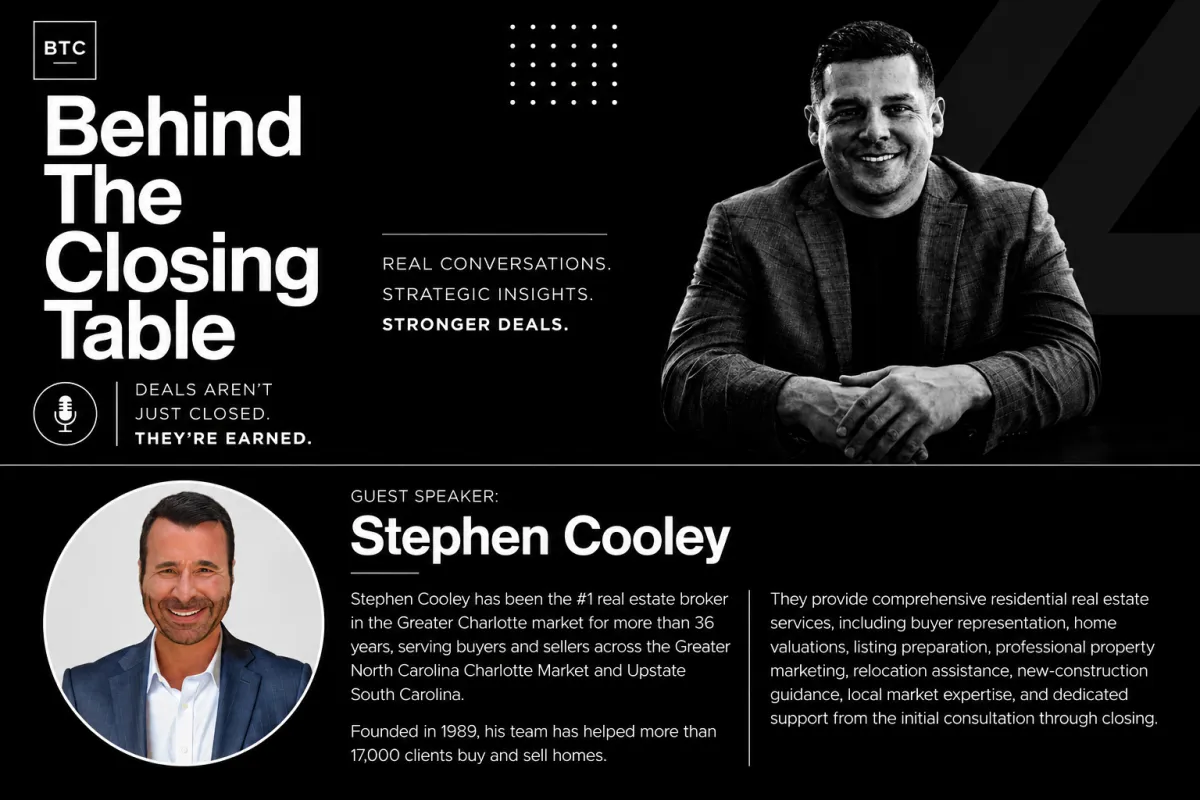
Matt Brady sat down with Stephen Cooley of Stephen Cooley Real Estate for a Behind the Closing Table episode unlike any other on the podcast. Thirty-seven years in the business. Over 17,000 clients served. Seven hundred homes sold in 2026 so far with a goal of twelve hundred by year end. Sixty-eight agents in production supported by twenty-four staff members. A marketing budget that has exceeded thirty million dollars over his career with two million going to billboards alone this year.
Stephen has been in real estate since 1989. He has survived ten major economic crises and ten personal ones that affected nobody but him. He was interviewed by Gary Keller during COVID for a session with a hundred thousand viewers on exactly how he did it. His answer then and his answer now is the same. You survive.
The Secret Is Surviving, Not Winning
Stephen makes a point early in the conversation that reframes how most people think about longevity in real estate. During the housing crash of 2006 to 2013 his business grew every single year while everyone around him closed. Closing attorneys, mortgage companies, real estate companies, and colleagues he had known for years all went under. He watched them go. He hired four of them rather than let them leave the industry.
His thesis is not that he is exceptionally talented. It is that he outlasted people who were. His competition was not that good and his willingness to survive when everyone else left the field created compounding advantages that are still paying out nearly four decades later.
He describes the seven-year crash as the hardest period not because of what it did to his business but because of what it did to the people around him. Sellers he had helped buy homes at $700,000 that were now worth $499,000. He did not hide from those calls. He answered every one, told the truth about the options including short sale and foreclosure, and kept every listing he could. At one point he had 200 active listings because everyone in the market knew he was not going anywhere.
From a Farm in Cooley Springs to the Top of the Charlotte Market
Stephen grew up on a farm in a town called Cooley Springs. His father had thirteen siblings and his extended family runs into multi-generations without a single generational wealth builder among them. He knew from watching his uncles bet on him to win the peach-picking race at age ten that he was built for commission-only work where output determined income rather than showing up and getting averaged in with everyone else.
He moved to Fort Mill in 1990 knowing no one. By 1992 he was the top agent in the MLS. In 1993 as a solo agent with no computer and no lead sources he sold 283 homes. He was on the national stage at the Association of Realtors in Atlanta explaining how a twenty-five-year-old without technology produced that volume. His answer was phones, doors, people, and the willingness to do it all day every day.
What a Thirty Million Dollar Marketing Education Looks Like
Stephen recognized early that in a business where twenty-seven thousand people can unlock a front door the agent who owns no patent and no unique inventory has exactly one differentiator available. Being genuinely good at the job and then going out and telling everyone about it.
He bought four pages of the newspaper when car dealerships were buying four or five. He took the first eight pages of all four real estate magazines that buyers picked up outside the Outback Steakhouse. He had his face on bathroom posters in bars around town. He signed agreements with venues, he bought billboards, and he kept scaling the marketing budget as the business grew. This year alone he is spending two million dollars on billboard campaigns across Charlotte.
His point is not that any single marketing vehicle is the answer. It is that he identified early that being known requires consistent investment in visibility and he has never stopped. He tracked each wave of media from newspaper to magazines to early internet to every social platform and maintained presence in each while the medium was growing rather than after it was saturated.
The Social Media Warning Every Newer Agent Needs to Hear
Stephen's take on social media is one of the most direct and useful pieces of advice in the conversation and it will not be what most agents expect to hear from someone who built his brand through marketing.
He believes the biggest waste of time and money for most real estate agents today is expensive social media video production. He watches agents hire film crews, rent Lamborghinis, borrow other agents' listings, and produce polished content that accumulates 300 followers none of whom live within a hundred miles of Charlotte.
His analysis is precise. A social media following of local buyers and sellers large enough to meaningfully drive real estate transactions probably requires somewhere around 200,000 local followers. To get there organically without being willing to do something outrageous or without a genuinely viral niche you are going to wait a very long time. The market is saturated and the content that gets large followings on these platforms is not usually real estate content from a specific local market.
What social media is actually good for is discoverability. When someone gets referred to you by a friend or finds your name through another channel and Googles you, your Instagram and your Facebook and your TikTok should show up, demonstrate that you are a real estate professional, and show some homes. That is the value. Not lead generation.
The agents spending fifteen hours a week on video production with three hundred followers while not making outbound calls are choosing the thing that feels productive over the thing that produces income.
What Would Stephen Do Starting Over Tomorrow?
Matt asked the question directly. If you took away the database, the team, the brand, and the thirty-seven years of relationships and started from scratch, how long would it take you to sell your first twenty-five homes?
Thirty days.
Stephen would get on the phone and make outbound calls eight hours a day. He would go where people with good credit tend to be and start having conversations. He would look people in the eye and ask them directly if they have real estate needs and if not who they know who does. He would not film a TikTok.
He shared a story from a convention in Austin, Texas, about the top agent in San Diego who knocked on doors in a city he did not live in just to maintain the habit. The agent came back with four referral listings. The habit of generating business through human contact does not stop working when technology advances. It just becomes rarer and therefore more valuable.
Building a Team the Right Way
Stephen is direct about the mistake most agents make when they decide to scale. The first hire is almost always a buyer's agent because the agent is tired of nights and weekends. That hire gives away fifty or sixty percent of income to someone with the same skill set and it has never worked consistently. The better path is cheap help first. A college student at ten dollars an hour. Then twenty dollars an hour. Handle the administrative burden before you outsource the revenue-generating work.
By 1995 at age twenty-six he had three secretaries who ran him rather than the other way around. They met him in the parking lot and dug through his car to find contracts and binder checks. They were the legs under the duck. He was the visible part. He scaled from that foundation to 500 homes a year before he ever built the larger team.
His current structure is sixty-eight agents in production supported by twenty-four staff members twenty-three of whom are licensed brokers. Transaction coordinators, listing coordinators, leadership, middle management. All licensed so they understand what they are supporting. At twelve hundred units planned for the year that support infrastructure is not optional.
He also notes that he is at level five and a half of the seven-level team model on his thirty-seventh year. Anyone trying to reach level seven on their second year in the business is pursuing something that does not exist yet for them. Level seven is the destination of a very long journey not the starting point.
What Separates Great Listing Agents From Average Ones
Stephen's answer is about positioning, marketing, and market knowledge rather than personality or relationships. A great buyer's agent is a personal shopper. They should be warm, patient, and skilled at understanding what a buyer actually needs as opposed to what they initially say they want. But that skill set does not automatically translate to listing excellence.
Great listing agents understand how to position a home in a market with six thousand competing listings. They know that price fixes all problems. They price with precision and they hold sellers accountable to the data rather than letting emotion drive the number. They take responsibility for the outcome rather than placing the blame for unsold listings on the market, the buyers, or the timing.
Stephen says he never blames sellers. He blames the agent. If the listing is not showing or not selling it is a pricing, condition, or marketing problem and those are the agent's responsibility.
He also draws a firm line on hiring people you cannot fire. Friends, neighbors, family members as your realtor or your contractor or your executive assistant all present the same problem. If you cannot reprimand or terminate them without destroying the relationship you should not enter the professional arrangement. This applies to agents choosing clients as well. Stephen does not take listings or buyers where the personal relationship prevents him from managing them as he would any other professional relationship.
What Buyers Consistently Worry About That Does Not Actually Matter
Stephen brings this back to the quality of representation. When a buyer from Dallas is relocating to Charlotte they do not need someone to unlock four doors they found on Zillow. They need someone who has already filtered 400 homes down to the four worth seeing, who understands the school districts, the doctors, the commute patterns, the soccer leagues, the trailing spouse's job opportunities, and who can look that family in the eye and tell them which of the four to buy.
That is the work that justifies the fee. Not the key. Not the showing. The expertise applied to the most significant financial and personal decision the family will make this decade.
Buyers worry about small things in homes that an experienced agent knows are either easily fixable or irrelevant to long-term value. What they should be focused on is whether the person representing them has the market knowledge to actually earn what they are being paid.
On Timing the Market
Stephen's answer on market timing is the most personal of the conversation. He separates houses from homes. If you are treating your home as a financial instrument to be bought and sold at the optimal moment you will have a miserable personal life and you will miss the purpose of what a home is supposed to provide.
When life tells you to buy a home you buy it. When life tells you to sell because of death, divorce, job change, or family growth you sell it. You do not time those decisions to the fed funds rate or the inventory level on Realtor.com. Life has its own timeline and real estate follows it not the other way around.
What Still Motivates Him After Thirty-Seven Years
The farm in Cooley Springs left him nothing. Multi-generations of family and not a single generational wealth builder among them. He is building what none of them did. Dynasty trusts designed to fund college educations for the next two hundred years for anyone in the family line. His own daughter. A niece through medical school. Godchildren whose educations are already funded. A health clinic he has supported for eighteen years that grew from 200 to 14,000 patients.
He wants to see the world in first class and take people with him. He is motivated by what the money makes possible for the people he loves and the community he has served for nearly four decades. And the tomorrow's client who has never heard of him deserves the same five-star service as the first client who did.
Five-Star Service Is the Standard
His challenge to his agents last week was to eat at McDonald's on a Tuesday and then at a high-end steakhouse on a Wednesday and take notes. The difference in how they were made to feel is the difference between what most real estate experiences deliver and what Stephen Cooley Real Estate is supposed to deliver.
Buyers and sellers at the closing table should feel like kings and queens for a day. They are making the most important financial decision of their lives and they deserve representation that rises to meet that moment. He has defined five-star real estate service in writing with checkboxes his agents complete for every client because the standard has to be specific to be real.
Seventeen thousand clients in the past. All happy. Tomorrow's client is the one that matters.
Sources
CharlotteRegionalRealtors.com
NAR.realtor
MortgageNewsDaily.com
NorthCarolinaRealtors.com
Investopedia.com
