

Your Local Mortgage Lender
Located in South and North Carolina
Personalized Mortgage Experience
Matt Brady offers personalized service and loan options you'll love. We shop multiple lenders to find the best rate and product for you, getting you into your dream home faster.
With wholesale interest rates and cutting-edge technology, we make the mortgage process seamless. Trust the experts who focus solely on mortgages. Support your local community and experience elite client service.
Let us help you achieve your homeownership dreams!
The Home Loan Process
Mortgage Pre-Approval
Get pre-approved from one of our Loan Officers to see how much you can afford.
House Shopping
Work with a trusted Real Estate Agent to find a home you would like to move into.
Loan Application
Complete your home loan application to get the lending process started.
Don't take my word for it
Mortgage Programs
Experience the best mortgage experience located in Clover,South Carolina.
Home Loan Options
Our experienced mortgage advisors will walk you through the best mortgage loan program that will fit your specific scenario.
Conventional Home Loans.
FHA Home Loans.
USDA Home Loans.
VA Home Loans.
Frequently Asked Questions
How often can I refinance my mortgage?
There is no limit to the number of times you can refinance. However, you must qualify every time you apply and there will be costs associated with closing the loan each time.
Can I buy a home if I do not have money for a down payment?
Yes! There are a number of bond programs that offer low or no down payment financing options.
How do I know which mortgage is right for me?
The key to choosing the right mortgage is to understand the range of options and features available to you, as well as your budget, circumstances, and goals. Our licensed mortgage professionals are here to help you navigate that process. The more you know, the more comfortable and confident you will be choosing the best option for you and your family.
How long will the loan process take?
The Truth in Lending Act (TILA) does not permit a lender to close a loan until at least seven (7) business days have passed from the date your application was received. A typical home loan takes 30 days, as a number of third-party services such as appraisals, title work, and credit are required in conjunction with the mortgage process. Once you familiarize your Loan Officer with the details of your specific loan scenario, they will be able to provide you with a more specific timeline.
Will I qualify for a home loan?
The only way to find out is to speak with a qualified mortgage professional. Our Loan Officers have helped numerous clients who didn’t know if they could qualify to become home owners. We take the time to understand your financial situation and long-term financial goals, and then match you with the loan program that best fits your needs. Your approval for a loan may also largely depend on the price of the home you are financing. Getting pre-qualified prior to beginning your home search can give you an idea of what you may be able to afford.
Why do people refinance their mortgages?
Homeowners typically refinance to save money, either by obtaining a lower interest rate or by reducing the term of their loan. Refinancing is also a way to convert an adjustable loan to a fixed loan or to consolidate debts.
How much money will I have to pay upfront to buy a home?
This question does not have a simple, one-size-fits-all answer. The exact amount will depend on the price of the home you buy as well the type of mortgage financing you choose. Depending on your loan program, your down payment could be as much as 20% of the home’s price or as little as 3%, while some loans require no down payment at all.
Can I get a mortgage after bankruptcy?
You may still qualify for a home loan even if you have experienced a bankruptcy. The best way to find out if you qualify is to talk with a Loan Officer to discuss your options. Be sure to bring all paperwork regarding your bankruptcy so your Loan Officer can find the program that best fits your situation.
Should I lock my interest rate now, or wait until we are closer to our closing?
Interest rates fluctuate all day, every day. If an interest rate is good, it may be in your best interest to lock now. If you wait, you run the risk of an increase in rates later. If you are concerned that rates may go down after you lock, contact your Loan Officer to discuss your options. Some programs allow you to lock for an extended period and choose to lower your rate should a better one become available.
Most Recent Blog Updates
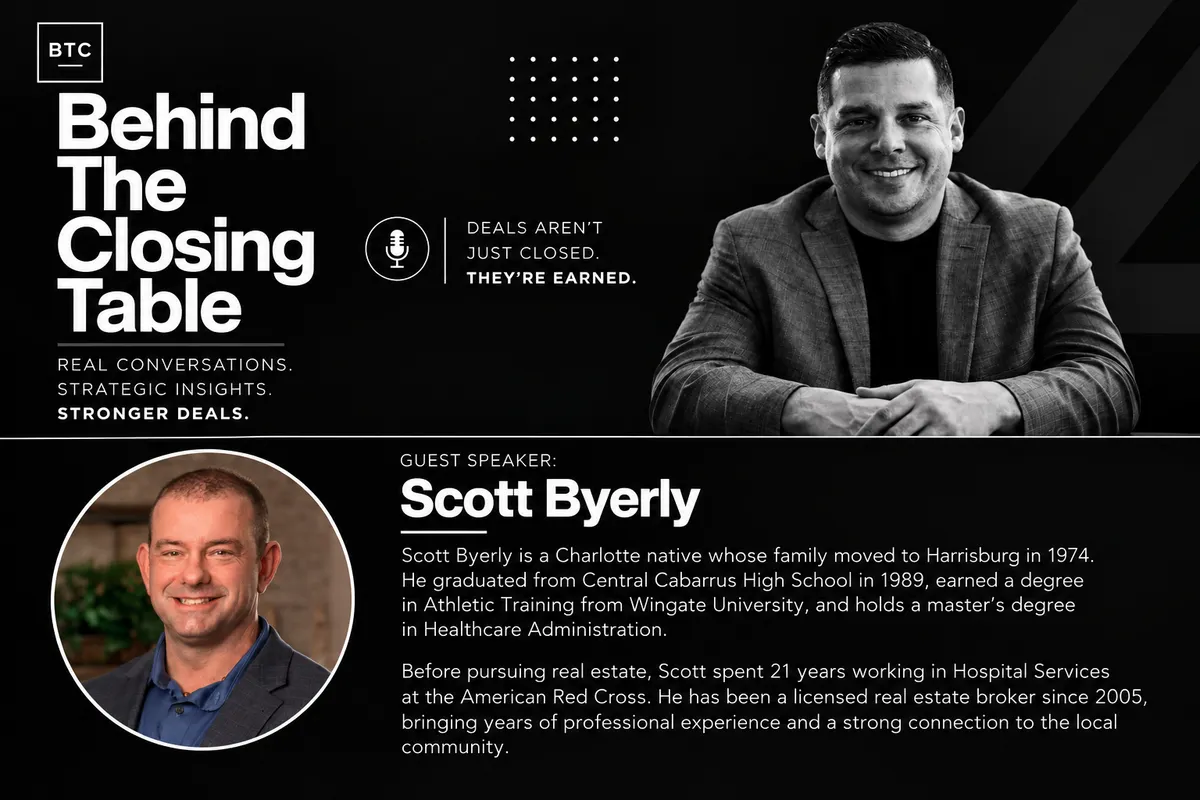
Behind the Closing Table: Matt Brady Talks Charlotte Market Negotiation and Longevity With Scott Byerly of Remax Executive
The American Red Cross Veteran Who Spent Twenty Years Watching Charlotte Transform
Matt Brady welcomed Scott Byerly of Remax Executive in Charlotte to Behind the Closing Table for one of the most experience-rich conversations the show has produced. Scott spent twenty-one years with the American Red Cross before transitioning fully into real estate in 2019 and has been a licensed North Carolina broker since 2005. His perspective on the Charlotte market is shaped not just by transactions but by watching the city grow from a place where uptown emptied out after five o’clock into one of the fastest-growing metros in the country.
Scott got his broker’s license on the advice of a teacher who told him legislation was changing and he should jump in immediately. He took the test, passed it the first time, went straight into the broker’s class without a single transaction on his record, and has never let his license lapse in the two decades since. He overlapped real estate and Red Cross for years before going full-time in 2019.
What He Saw in 2005 That Led Him to Leave His First Firm
Scott entered real estate during what he describes as the wild west. Builders were bringing food and offering five and ten thousand dollar bonuses on homes weekly. Subprime lending was everywhere. Within his first two transactions at his initial firm he recognized something was wrong with how they were conducting business with clients. He moved on. He later found out they went to prison for putting people into products they could not afford.
That early experience shaped his entire approach to the industry. Recognizing what feels wrong and acting on that recognition rather than staying because things are moving is a skill he traces directly to those first years.
How the Red Cross Years Translate to Real Estate
The connection between emergency blood supply coordination and buying and selling homes is not obvious until Scott explains it. With the Red Cross he knew every phone call and subsequent action was going to help a patient he would never meet. With real estate he is directly in front of the person whose goal he is helping achieve. More direct impact. Same underlying orientation toward helping people as the purpose behind the work.
The discipline piece also transferred cleanly. A career built around structured shifts and accountability made setting a self-directed real estate schedule straightforward. He kept doing what he normally did. The freedom of the schedule did not become permission to do nothing.
What Newer Agents Get Wrong in a Difficult Market
The biggest mistake Scott sees from agents who have never experienced a truly difficult market is not educating themselves. Getting the license is step one. Learning enough to actually serve clients at a high level requires designations, time spent in front of lenders and experienced agents, and a genuine investment in understanding products and tools that most agents have never heard of.
He makes the point in a specific way. If a lender mentions a two-one buydown, a seven-six ARM, or seller concessions structured toward a rate buydown and the agent stares back with no idea what any of that means the client is not being served. Not knowing means not being able to help clients understand their options. Education enables education.
His solution is the same one that worked for his mentee who has closed five deals in her first three months. Get on a team. Use the split as an investment in the experience, the coaching, the leads, and the collective knowledge that a solo agent building from scratch cannot replicate. A hundred percent of nothing is still nothing.
Charlotte Then and Now
Scott grew up here and has watched the transformation in a way that only a long-term local can. When 277 was considered the outer loop. When uptown was called downtown and cleared out after five o’clock because there was nothing there. When you could drive through Indian Land and see farms and rolling hills in every direction.
That landscape is gone and the growth that replaced it has been dramatic. Uptown became a genuine urban destination with retail, restaurants, and residential space for young professionals. The outlying areas followed. Indian Land, Belmont, Waxhaw, Mint Hill, Matthews all reflect the same outward pressure of a city that has become one of the top relocation destinations in the country.
He is direct about the traffic consequences. If you know the Buster Boyd Bridge you know exactly what he means when he says you have to decide by three-thirty which side of the bridge you want to be on. People who do not live here do not understand that going through Rock Hill can be faster than going the straight shot home depending on timing.
What He Recommends Buyers Overlook Right Now
Scott’s overlooked community picks for buyers are Mint Hill and Matthews which have remained solid without the explosion that has hit some areas. Belmont is growing and prices are moving up but it offers good proximity to the airport for buyers who need that. He steers investors away from South Carolina by simply explaining the property tax structure for non-owner occupied properties. Most of them change course immediately once they understand the difference.
What Relocation Buyers Get Wrong About Charlotte
People moving from the Northeast, California, and across the country are consistently surprised by how pleasant the community is. What Scott focuses on is making sure they understand the market they are moving into rather than relying on information that may apply to their origin state but not to the Carolinas.
He mentions the ChatGPT problem directly. He encountered a buyer from California who planned to use the app to find what he needed. His wife handed Scott her number while her husband was still talking. Scott’s position on AI is nuanced and honest. It has legitimate uses for listing descriptions and workflow. It gives you what you put in and needs to be fact-checked. It does not replace someone who knows the local market, understands the rules as they apply here, and will still be responsible for the outcome when something goes wrong.
The First Question He Asks Every Relocating Family
Are schools important? That question comes first every time a family with school-age children comes through. The answer determines which communities to show them and which price points make sense within those communities. He notes that he recently encountered a family evaluating neighborhoods based on the football program quality for an athletic son heading toward D1 aspirations. His response was to get the details on what the family actually needed and find communities that could support that goal. Every client situation has specifics that a generic neighborhood list cannot anticipate.
How He Handles Sellers Who Bought During COVID and Expected It to Last
Scott does not have much patience for rate expectations anchored to what he calls an artificial economy. COVID rates were not real in the sense that no bank is in business to give away free money. He tells sellers who bought during that window that they captured real equity growth and that equity is still there. The pain that is motivating the conversation now is about something specific in their current situation. His job is to understand what that pain is and find the path that uses available tools including rate buydowns and seller concessions to get them to a payment that works in the current environment.
He paid thirteen and a quarter percent when he bought in 2007 on a stated no-doc loan. He does not have a great deal of sympathy for complaints about seven and a quarter. Over a forty-year average the current rate is about normal. Understanding that frame helps sellers let go of the expectation that their rate experience from 2021 is the benchmark everything should be measured against.
What Sellers Misunderstand About Pricing
Zillow is wrong most of the time. That is Scott’s opening position and he backs it up immediately by walking sellers through actual comparable sales and current competitive inventory. The question is not what the house is worth in the abstract. The question is what buyers in this specific market are paying for comparable homes right now and whether the seller wants to compete with that reality or fight it.
He gives a specific example from a listing in Mint Hill where an unrepresented buyer offered eighteen thousand below asking. His sellers wanted to decline immediately. He pulled out the net sheet, removed the buyer agent commission the seller would not be paying, and showed them the net was identical at the lower price. The seller accepted and they closed. The price on the paper was less. The money in the seller’s pocket was the same.
The Most Overlooked Part of Negotiating a Purchase Contract
Seller concessions structured toward a rate buydown produce more benefit per dollar than most price reductions of equivalent size. A twenty thousand dollar price reduction might lower a monthly payment by sixty to eighty dollars. That same twenty thousand directed toward a rate buydown can lower the payment by five or six hundred dollars in the first year depending on the loan amount.
Matt reinforces this from the lending side. A refinance will eventually happen for most buyers and every refinance comes with costs regardless of how it is marketed. If seller concessions can offset closing costs at purchase the buyer is preserving cash that would otherwise go to a future transaction with its own expense. Getting seller help with closing costs now is keeping real money in the buyer’s pocket rather than deferring the cost to a refinance.
The Most Reliable Way He Has Built His Business
Staying in touch with past clients. Over fifty percent of his transactions in recent years have come from existing relationships. He uses the Buffini program, sends monthly content, and reaches out consistently around holidays and touchpoints throughout the year. His pie giveaway before Thanksgiving is a standing example.
The case he makes for this approach borrows from the restaurant industry analogy. It costs more to acquire a new customer than to keep an existing one. If you are spending time and money chasing new leads while ignoring people who already trust you and could refer their friends and family you have the priorities backwards. Some clients take a month to be ready. Some take eighteen months. If you are there consistently when they are ready you get the call.
What He Wants Clients to Remember When They Leave the Closing Table
That he genuinely cared about their experience and finding the home that was the best fit for them and their family. Not his timeline. Theirs. Never rushed. Providing information when they had questions and letting them make the decision. The reviews that come back consistently are about never feeling pressured throughout the process. That outcome is not accidental.
Scott closes with his baseball championships on the table in front of him. Seventeen years in the Charlotte Adult Baseball League. Two age-division brackets. Still playing and still winning. Real estate may be his career but the competitive drive that keeps him on the field in his fifties is the same one that makes him cut grass for a client’s backyard the day before they move in from Colorado.
How to Reach Scott Byerly
Contact information is available through Remax Executive in Charlotte. Scott works with buyers, sellers, and investors across the Charlotte metro and surrounding Carolinas and mentors newer agents through the team structure.
Matt Brady, the Carolina Mortgage Coach, is available for pre-approval conversations, loan structure analysis, and the kind of option presentation that gives buyers and sellers the full picture before they make decisions. Reach out to Matt Brady to connect on the lending side of any Charlotte-area transaction.
Sources
CharlotteRegionalRealtorsAssociation.com
NAR.realtor
MortgageNewsDaily.com
ConsumerFinancialProtectionBureau.gov
Investopedia.com

Mortgage Calculator
See your total mortgage payments using the tool below.
| Year | Interest | Principal | Balance |
|---|

Social Media Links
YouTube
