
Your Local Mortgage Lender
Located in South and North Carolina
Personalized Mortgage Experience
Matt Brady offers personalized service and loan options you'll love. We shop multiple lenders to find the best rate and product for you, getting you into your dream home faster.
With wholesale interest rates and cutting-edge technology, we make the mortgage process seamless. Trust the experts who focus solely on mortgages. Support your local community and experience elite client service.
Let us help you achieve your homeownership dreams!
The Home Loan Process
Mortgage Pre-Approval
Get pre-approved from one of our Loan Officers to see how much you can afford.
House Shopping
Work with a trusted Real Estate Agent to find a home you would like to move into.
Loan Application
Complete your home loan application to get the lending process started.
Don't take my word for it
Mortgage Programs
Experience the best mortgage experience located in Clover,South Carolina.
Home Loan Options
Our experienced mortgage advisors will walk you through the best mortgage loan program that will fit your specific scenario.
Conventional Home Loans.
FHA Home Loans.
USDA Home Loans.
VA Home Loans.
Frequently Asked Questions
How often can I refinance my mortgage?
There is no limit to the number of times you can refinance. However, you must qualify every time you apply and there will be costs associated with closing the loan each time.
Can I buy a home if I do not have money for a down payment?
Yes! There are a number of bond programs that offer low or no down payment financing options.
How do I know which mortgage is right for me?
The key to choosing the right mortgage is to understand the range of options and features available to you, as well as your budget, circumstances, and goals. Our licensed mortgage professionals are here to help you navigate that process. The more you know, the more comfortable and confident you will be choosing the best option for you and your family.
How long will the loan process take?
The Truth in Lending Act (TILA) does not permit a lender to close a loan until at least seven (7) business days have passed from the date your application was received. A typical home loan takes 30 days, as a number of third-party services such as appraisals, title work, and credit are required in conjunction with the mortgage process. Once you familiarize your Loan Officer with the details of your specific loan scenario, they will be able to provide you with a more specific timeline.
Will I qualify for a home loan?
The only way to find out is to speak with a qualified mortgage professional. Our Loan Officers have helped numerous clients who didn’t know if they could qualify to become home owners. We take the time to understand your financial situation and long-term financial goals, and then match you with the loan program that best fits your needs. Your approval for a loan may also largely depend on the price of the home you are financing. Getting pre-qualified prior to beginning your home search can give you an idea of what you may be able to afford.
Why do people refinance their mortgages?
Homeowners typically refinance to save money, either by obtaining a lower interest rate or by reducing the term of their loan. Refinancing is also a way to convert an adjustable loan to a fixed loan or to consolidate debts.
How much money will I have to pay upfront to buy a home?
This question does not have a simple, one-size-fits-all answer. The exact amount will depend on the price of the home you buy as well the type of mortgage financing you choose. Depending on your loan program, your down payment could be as much as 20% of the home’s price or as little as 3%, while some loans require no down payment at all.
Can I get a mortgage after bankruptcy?
You may still qualify for a home loan even if you have experienced a bankruptcy. The best way to find out if you qualify is to talk with a Loan Officer to discuss your options. Be sure to bring all paperwork regarding your bankruptcy so your Loan Officer can find the program that best fits your situation.
Should I lock my interest rate now, or wait until we are closer to our closing?
Interest rates fluctuate all day, every day. If an interest rate is good, it may be in your best interest to lock now. If you wait, you run the risk of an increase in rates later. If you are concerned that rates may go down after you lock, contact your Loan Officer to discuss your options. Some programs allow you to lock for an extended period and choose to lower your rate should a better one become available.
Most Recent Blog Updates
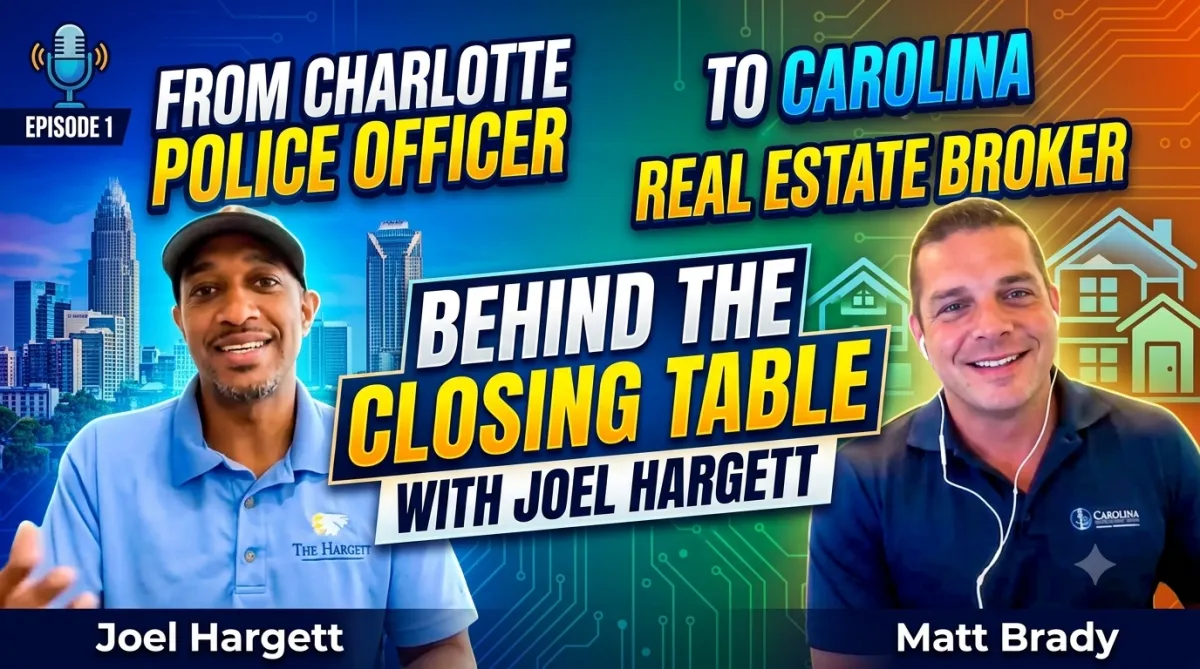
Behind the Closing Table With Joel Hargett: From Charlotte Police Officer to Carolina Real Estate Broker
A Story That Started With a Prayer and Turned Into a Career
Matt Brady sat down with Joel Hargett of the Carolinas for another Behind the Closing Table episode and the conversation covered everything from how a Charlotte police officer ended up in real estate to hidden gem neighborhoods that more buyers should know about and the myth that experience alone makes a great agent.
Joel's story begins in a way that does not show up in most real estate origin stories. He was a cop in Charlotte with a wife and three kids and not enough time at home. One afternoon he was downstairs praying about whether there was something else he could do and real estate came to mind immediately. He looked up a licensing class and the available dates aligned perfectly with his next stretch of days off. He went full speed ahead and has not looked back in seven years.
How the Transition Actually Happened
Joel did both jobs for about four months. When he knew his first closing was going to happen he sent his notice to the police department. The closing date arrived and so did COVID which shut down in-person showings across the city the same day. He was a newly full-time real estate agent who could not show homes in person.
It turned out to be a blessing in disguise. He found his footing, the market adapted, and seven years later he has been a team leader, is currently coaching agents at another firm, and has built a practice grounded in relationships that turn clients into lifelong friends.
What Makes Joel Different
When Matt asked what past clients would say makes Joel different the answer was immediate and consistent with how he has built the business. He genuinely cares and it is not about the money. He wants to know about his clients' lives. He wants to bring them into his circle. When someone becomes a client they become a client for life and a friend.
He describes his approach as relational rather than transactional and the distinction shows up in how he handles every aspect of the work.
The Biggest Mistakes Joel Sees Repeatedly
On the seller side the most consistent mistake is overpricing. The COVID market pushed prices dramatically and when the correction came some sellers held onto peak-era price expectations. An overpriced home sits longer. The longer it sits the more it signals to buyers that something is wrong. The eventual sale price ends up lower than it would have been with accurate initial pricing. The math consistently favors pricing correctly from the start over chasing a number the market will not support.
On the buyer side the biggest mistake is starting the home search before talking to a lender. Joel is direct about why. If a buyer is qualified for $400,000 but they have been looking at $600,000 homes without knowing their limit every $400,000 home they see is going to disappoint them because their reference point is entirely wrong. Getting pre-approved first sets the right expectations and makes the decision process considerably cleaner.
Matt Brady added the rate cushion conversation he now has with every pre-approved buyer. Rather than focusing on a specific rate he shows clients what the payment looks like at the current rate, a quarter percent better, and a quarter percent worse. If the buyer can handle all three scenarios the rate becomes something they stop worrying about because it is going to be whatever it is when they find the house. Taking the rate anxiety off the table makes buyers more decisive and more competitive.
Joel reinforced the payment perspective with a simple reframe. Breaking a $20,000 gap between offer price and asking price down to a hundred dollar monthly payment difference changes how buyers think about the decision. Nobody wants to miss the right house over a hundred dollars a month. Putting it in those terms helps buyers act instead of hesitate.
Renovations That Add Value and Ones That Do Not
Kitchens and bathrooms consistently add value when done tastefully. New flooring adds value. These are the improvements that move buyers and justify higher prices.
The mistake Joel sees repeatedly is sellers who count a new roof, a new water heater, or a new HVAC system as value-adding improvements in the same category as kitchen and bath updates. Those mechanical improvements are genuinely helpful and they make a home easier to sell and more appealing to buyers. But they fall into the category of general maintenance and upkeep rather than value-adding renovation. They will not produce the price increase sellers often expect from them.
Hidden Gem Areas in the Carolinas
Joel highlights Still Creek and the River District as areas with significant new construction activity and strong walking trails and community infrastructure. York, South Carolina is building up with strong value available. Clover, South Carolina is in the early stages of a growth trajectory that Matt Brady can personally confirm from his own experience. His home in the Clover Lake Wylie area has nearly doubled in value over six years and the area continues to attract new residents and development.
On the North Carolina versus South Carolina question Joel is transparent about his bias as a Charlotte native but offers a practical consideration for investors. Investment property tax rates in South Carolina are higher than primary residence rates in a way that affects the financial analysis on rental properties. For primary residence buyers the decision comes down to lifestyle preference. Both states offer lakes, mountains within a few hours, beaches within a few hours, a major airport, professional sports, and a strong events and entertainment calendar.
The traffic around the Buster Boy Bridge did come up as a legitimate consideration for buyers looking at the Lake Wylie corridor and both Matt and Joel confirmed the wisdom of knowing which side of the bridge you want to be on before three in the afternoon.
What Separates Agents Who Last From Those Who Flame Out
Joel coaches agents and his observation on why some succeed and others do not is direct. The ones who succeed take action. Not the ones who go to every class and absorb every piece of training but never implement it. Action under uncertainty and even under fear is what builds a real estate business. Without it no amount of education produces results.
On the question of teams versus independent mentorship Joel frames it around personality type using the DISC profile framework. A high-D driver personality who will take action regardless may do well with a mentor and more independence. Someone who needs leads, reps, and structured coaching to build momentum may be better served by a team where the brokerage has an invested interest in their success. Neither path is universally right and neither is wrong. The right choice depends on how fast you need to make money, your comfort with uncertainty, and what kind of support structure helps you take action consistently.
He also recommends asking about brokerage caps, training structures, and monthly fees when interviewing brokerages. His own early years at Keller Williams SouthPark gave him training he credits as foundational to everything that came after. The commission split matters less than the education when you are building the foundation for a career rather than just a job.
The Myth Worth Debunking
The myth Joel wants gone is the idea that experience alone guarantees quality. He has seen agents with decades in the business who are resting on their reputation rather than staying current on contracts, laws, and market conditions. He has also seen those knowledge gaps show up in transactions in ways that hurt clients on the other side. Constant learning and consistent implementation are what produce quality work. Tenure by itself does not.
Advice for Anyone Thinking About Buying or Selling in the Next Year
Joel's advice is the same regardless of the timeline. Reach out to a lender and a real estate broker and build a game plan before you need to act. Know your comfortable monthly payment. Understand your purchasing power. Define your buy box. Know your non-negotiables and what you can flex on. When that preparation is done before the urgency arrives you are never behind the eight ball on a decision that matters.
Joel Off the Clock
When Joel is not working he is at church, at CrossFit, at his kids' soccer games, or drinking coffee. He is a self-described Olive Garden enthusiast despite some pushback from friends who prefer more authentic Italian. He grew up in North Carolina and if he could live anywhere outside the Carolinas he is genuinely torn between Boston and Florida, which he acknowledges are about as opposite as two places can be depending on the time of year. Something most people do not know about him: he got his eye glued shut accidentally in high school.
How to Reach Joel Hargett
Call or text Joel at 704-996-6496. Find him on Instagram at JoelHargettSellsHomes or on Facebook at Joel Hargett. Matt Brady at Success Lending is the mortgage partner behind every deal. Behind the Closing Table continues with more conversations from the people making real estate happen across the Carolinas and beyond.
Sources
CharlotteRegionalRealtors.com
NAR.realtor
MortgageNewsDaily.com
NorthCarolinaRealtors.com
Investopedia.com

Mortgage Calculator
See your total mortgage payments using the tool below.
| Year | Interest | Principal | Balance |
|---|

Social Media Links
YouTube
